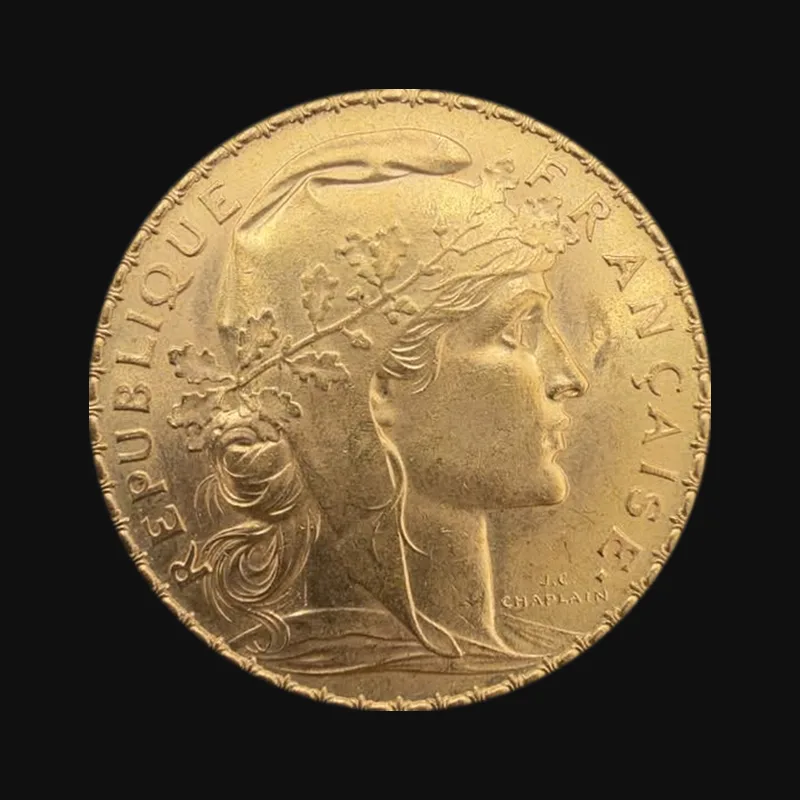
Obverse
Marianne in profile, looking right, wearing the Phrygian cap topped with oak leaves. Around her, “RÉPUBLIQUE FRANÇAISE”.
Written by the Maison Or & Bijoux Mougins team · updated
| Country | France |
|---|---|
| Metal | Gold, 900‰ fine, barely less on the restrikes |
| Weight | 6.45 g |
| Fine gold | 5.806 g |
| Diameter | 21 mm |
| Thickness | 1.30 mm |
| Years struck | 1899-1914; 1921 (dated 1914); 1951-1960 (dated 1907-1914) |
| Mint | Paris, with no mint mark |
| Period mintage | 117,448,888 in all (first type 43,034,473, second type 74,414,415) |
| Restrikes | 37,483,500 |
| References | F.534 (first type), F.535 (second type) |
The last type of gold 20 francs issued by republican France, Jules-Clément Chaplain's Rooster was made in Paris from 1899 to 1914. Its production did not stop with the war: a batch dated 1914 still came out in 1921, then the Mint restruck the dates 1907 to 1914 between 1951 and 1960. A very widespread coin, it really draws collectors only for a few low-mintage years and for examples in fine condition.
Marianne in profile, looking right, wearing the Phrygian cap topped with oak leaves. Around her, “RÉPUBLIQUE FRANÇAISE”.
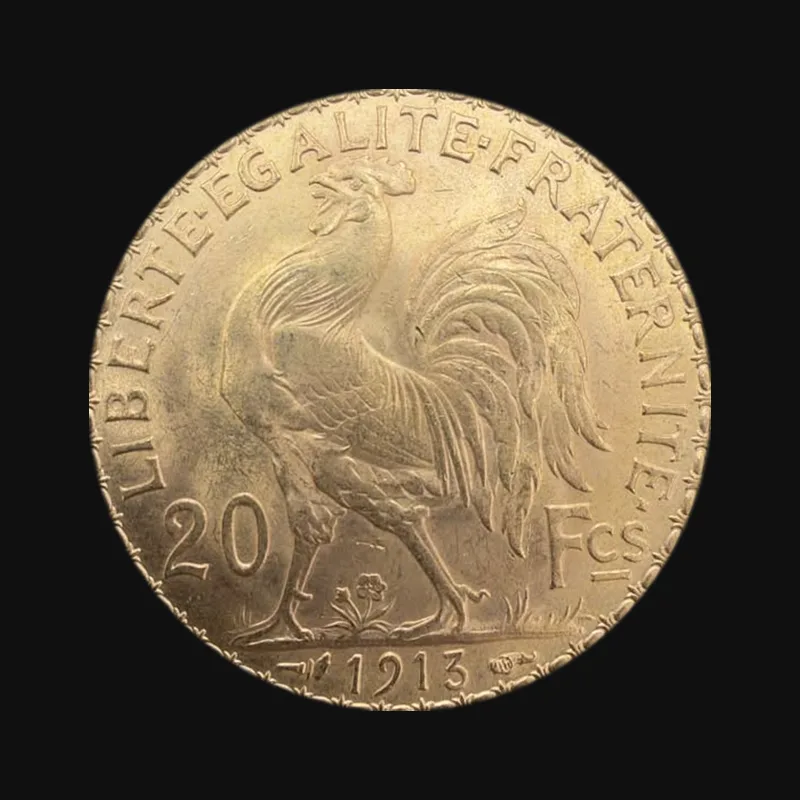
An upright rooster advancing to the left, framed by “20 FRANCS” and the date, with the republican motto “LIBERTÉ ÉGALITÉ FRATERNITÉ” running around the edge of the field. No mint letter appears anywhere.
The years 1899 to 1906 are all period strikes. The years 1907 to 1914 mix period coins and restrikes, and the table lists only the former. Four dates stand out: 1900 first, then 1899, 1902 and 1901.
| Year | Edge type | Mintage | Note |
|---|---|---|---|
| 1899 | Dieu protège la France | 1,500,000 | Start of the type; matt flans |
| 1900 | Dieu protège la France | 605,982 | Scarcest date; matt flans (9,443) |
| 1901 | Dieu protège la France | 2,643,350 | Lightly struck |
| 1902 | Dieu protège la France | 2,393,707 | Lightly struck |
| 1903 | Dieu protège la France | 4,405,175 | Widespread |
| 1904 | Dieu protège la France | 7,705,674 | Widespread |
| 1905 | Dieu protège la France | 9,158,132 | Widespread |
| 1906 | Dieu protège la France | 14,613,010 | Closes the first type |
| 1907 | Liberté égalité fraternité | 17,715,935 | Most struck year; restruck |
| 1908 | Liberté égalité fraternité | 6,721,325 | Restruck after 1951 |
| 1909 | Liberté égalité fraternité | 9,636,955 | Restruck after 1951 |
| 1910 | Liberté égalité fraternité | 5,779,072 | Restruck after 1951 |
| 1911 | Liberté égalité fraternité | 5,346,044 | Restruck after 1951 |
| 1912 | Liberté égalité fraternité | 10,331,805 | Restruck after 1951 |
| 1913 | Liberté égalité fraternité | 12,163,138 | Restruck after 1951 |
| 1914 | Liberté égalité fraternité | 6,720,141 | Of which 202,359 from 1921; restruck after 1951 |
Mintages taken from French Wikipedia (after Le Franc) and compared with those of BDOR. There is one gap: for 1900, BDOR shows 615,425, a figure that adds up regular coins and matt flan coins. The restrikes, 37,483,500 coins in all, are not included; no source seen gives their breakdown by date.
In 1899, the Third Republic retired the 20 francs Genius and entrusted a new type to the medallist Jules-Clément Chaplain. The module did not move: weight and fineness remained those of the germinal franc of 1803, as on the Napoleon I 20 francs or the Napoleon III 20 francs.
In 1907, the edge dropped “DIEU PROTÈGE LA FRANCE” (God protect France) for the motto of the Republic; the law separating the Churches and the State dates from 1905. With the Great War, gold vanished from trade, and from 1915 the poster “Pour la France, versez votre or” called on people to hand it in for banknotes. Regular striking stopped after 1914, yet 202,359 coins dated 1914 were still made in 1921.
The final chapter ran from June 1951 to 1960: 37,483,500 restrikes dated 1907 to 1914, produced from the old dies. French Wikipedia sees them as a way for the State to weigh on gold that had become too dear on the free market. The name “Pinay restrikes” comes from Antoine Pinay, head of government in 1952, even though the first ones predate him.
A restrike is not a fake. It came out of the official mint, with the original dies and the statutory weight. What sets it apart is when it was made and a slightly more coppery alloy: 897.3 thousandths according to French Wikipedia, 898 to 900 according to AuCOFFRE. Hence, at times, a redder gold, and a condition that is often very fresh since these coins circulated little.
These clues prove nothing on their own. Toning or lighting changes the colour, and some period coins slept untouched in bags. An alloy analysis remains the only way to know for certain. Of all the coins struck with the dates 1907 to 1914, nearly one in three is a restrike, but nobody knows what proportion survives today.
If your coin bears a date from 1899 to 1906, the question does not arise: it is a period strike, which collectors appreciate.
The Rooster shares its measurements, 6.45 g of 900 fine gold over 21 mm, with every 20 francs coin struck to the French standard. The countries that signed the 1865 convention of the Latin Monetary Union, Belgium, Italy and Switzerland, followed by Greece in 1868, adopted this standard. On the scale, nothing separates them; the legend, however, does not lie: only the Rooster carries “RÉPUBLIQUE FRANÇAISE” around Marianne.
The closest case is the Swiss Vreneli. Struck in Bern from 1897, it is an exact contemporary of the Rooster and, like it, saw fresh strikings after 1945. It is recognised by the word “HELVETIA” and by the letter B for Bern, whereas the Rooster has no letter.
Among French coins, the Ceres of 1849-1851 and the 19th-century napoléons carry a mint letter and a “DIEU PROTÈGE LA FRANCE” edge: a Rooster from 1899 to 1906 has the same edge inscription, but never a letter.
The most sought-after coins of the series are those on a matt flan, in 1899 and 1900, recognisable by their surface without shine. Among regular coins, 1900 is the scarcest date (605,982 examples), ahead of 1899, 1902 and 1901. Le Franc also records an 1898 pre-series on matt flan, unknown in inheritances. As for the 1921 batch, it bears the date 1914 and cannot be picked out.
Fakes exist, including in gold of the correct fineness. First test: whether date and edge agree. A 1906 with the republican motto or a 1908 with “DIEU PROTÈGE LA FRANCE” is impossible. Second test: the measurements, 6.45 g, 21 mm and 1.30 mm, with wear removing only a few hundredths. Third test, under a loupe: Marianne's hair poor in detail, clogged rooster feathers, irregular edge letters, a beaded border lacking sharpness. The guide to spotting a fake coin (in French) goes through these checks.
On Marianne, look first at the hair above the forehead and the oak wreath: these are the reliefs that fade first, before the cheekbone and the lower part of the cap. A Very Fine coin (TTB in French grading) keeps distinct strands and veined leaves; a Fine coin (TB) has nothing left but a smooth mass of hair.
On the rooster, the breast wears first, then the wing and the comb. Extremely Fine (SUP) shows breast feathers that can all be read.
The large flat areas on each side of the rooster and behind Marianne's head pick up knocks and scratches. A coin kept in a bag for a long time can carry such marks without having circulated: they lower the grade. Do not rub the coin; see why not to clean a coin and the grading guide (both in French).
No striking or monetary event ties the 20 francs Rooster to Mougins in particular: it is a national coin, from the Paris mint alone. In families around Grasse, as elsewhere, it was above all kept as savings once gold had left circulation. An estate box may hold it together with other coins of the same weight, French or foreign, such as the Vreneli or the Latin Union 20 francs: the legend is enough to sort them before showing them to a numismatist at the Mougins shop.
For the dates 1899 to 1906, the matter is settled: no restrike exists. For 1907 to 1914, a redder tint and unusual freshness point towards a restrike without proving it. Only an alloy analysis confirms it.
Yes. Both follow the same standard: 6.45 g of gold at 900 thousandths, i.e. 5.806 g of fine gold. The Pinay restrike of the Rooster has a barely lower fineness.
The Republic replaced “DIEU PROTÈGE LA FRANCE” with its motto two years after the 1905 law on the separation of the Churches and the State. All restrikes carry the new edge.
1900, the scarcest with 605,982 coins, above all on matt flan (9,443 examples). Then 1899, 1902 and 1901, all of the first type.