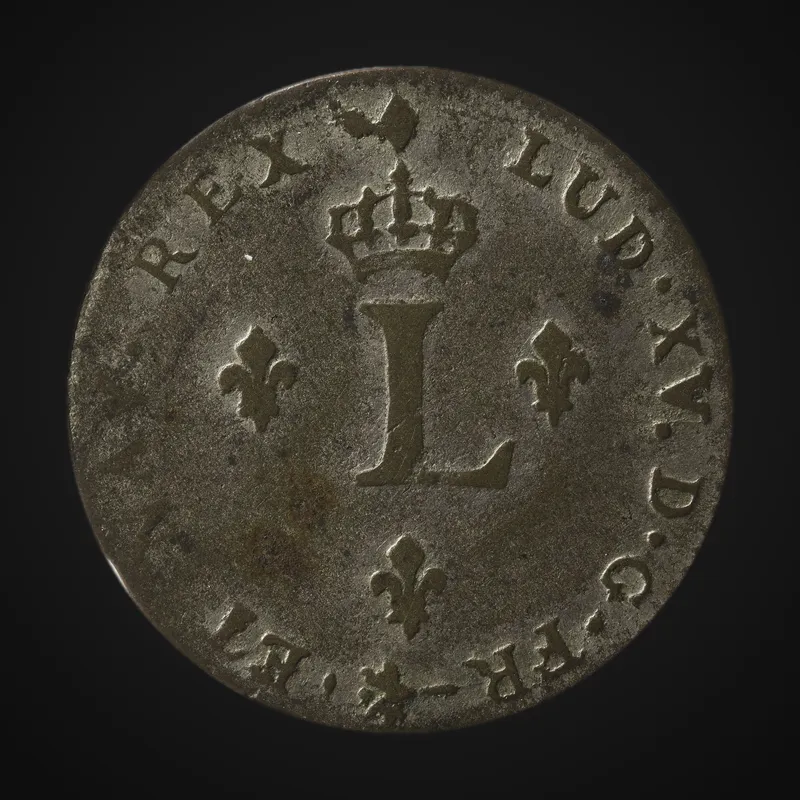
Obverse
A capital L beneath a closed crown, between three fleurs-de-lis set two and one. Around it, “LUD. XV. D. G. FR. ET NAV. REX”: Louis XV, by the grace of God, King of France and Navarre.
Written by the Maison Or & Bijoux Mougins team · updated
| Country | France |
|---|---|
| Metal | Billon, an alloy of copper and silver: 208‰ silver according to Numista, 250‰ according to Coinvarieties |
| Weight | Double sol: 2.18 g; sol: 1.09 g |
| Diameter | Double sol: 21 to 22 mm; sol: 17 to 19 mm |
| Denomination | Double sol = 2 sols = 24 deniers; sol = 12 deniers |
| Years struck | Double sol: 1738-1764; sol: 1739-1748, mostly 1740 |
| Mints | About thirty for the double sol, from A (Paris) to & (Aix-en-Provence) and 9 (Rennes) |
| Engraver | Joseph-Charles Roettiers |
| Edge | Plain |
| Demonetised | 10 July 1845 |
| References | Double sol: Duplessy 1690, Ciani 2138, KM 500; sol: Duplessy 1691, Ciani 2140, KM 501 |
A thin, small coin, grey or almost black, with a large crowned L between three fleurs-de-lis: it is almost always a sou marqué, the billon double sol of Louis XV. Struck from 1738 in tens of millions and still in use until 1845, it turns up again and again in family drawers. Its smaller sibling, the sol aux deux L, is far scarcer, and the copper sols of the same reign belong to a different family.
A capital L beneath a closed crown, between three fleurs-de-lis set two and one. Around it, “LUD. XV. D. G. FR. ET NAV. REX”: Louis XV, by the grace of God, King of France and Navarre.
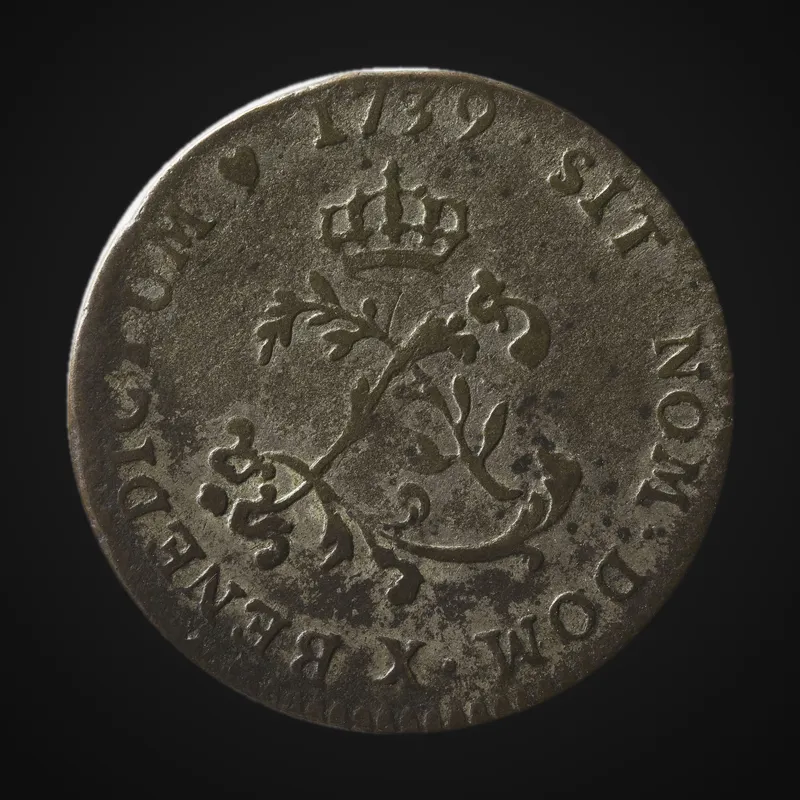
A cursive L interlaced with a branch, under a crown, with the mint letter at the bottom. The legend “SIT NOM. DOM. BENEDICTUM” (blessed be the name of the Lord) is followed by the date.
The table brings together the small coins that circulated under Louis XV, in billon and in copper, to help tell them apart. Start with metal and weight; the mintages are given as landmarks and do not cover every mint.
| Type | Years | Metal and weight | Notable mints and mintages | Remarks |
|---|---|---|---|---|
| XXX deniers with crowned Ls, known as the “mousquetaire” (for reference) | 1709-1713 | Billon 208‰, 2.44 g | AA (Metz) and D (Lyon) only; 1713 D: 10,381,339 | A coin of Louis XIV, not Louis XV |
| Sol with the child bust | 1719-1728 and 1734 | Copper, 12.23 g | 1719 A: 2,037,600; 1720 S: 1,632,170 | Only the early years are common |
| Sixteen deniers “produit des mines de France” | 1721-1728 | Copper, 12.23 g | Pau only; mintage n/a | Sometimes wrongly listed as billon, according to Coinvarieties |
| Double sol with two crowned Ls (sou marqué) | 1738-1764 | Billon, 2.18 g, 21-22 mm | 1739 A: 8,068,970; 1739 W: 6,475,088; 1738 &: 57,000 | About 81 million in all according to Droulers |
| Double sol, scarce dates | 1738, 1752 | Billon, 2.18 g | 1738 9 (Rennes): 2,536; 1752 C (Caen): 5,439 | The lowest mintages recorded by Numista |
| Sol with two crowned Ls | 1739-1748 | Billon, 1.09 g, 17-19 mm | 1740 BB: 83,904; 1739 A: approx. 57,400; 1748 A: approx. 19,600 | About 2.3 million in all, nearly all dated 1740 |
| Sol tampé (crowned C) | from 1763 | Billon, on worn sous marqués | Countermark applied in France for the colonies | The C stands for “colonies”, not Cayenne |
| Sol and half sol of Aix | 1766-1773 | Copper, 12.23 g (sol) | & (Aix) only | Covered on the liards and sols page |
| Sol with the old head | 1768-1774 at Paris according to Coinvarieties | Copper | A, AA, BB, S, W, ϽC… | Copper, outlined on the neighbouring page |
Mintages from Numista (double sol, by date and mint) and Coinvarieties, which cites Droulers (Répertoire général, 4th ed.) for the mousquetaire, the sol aux deux L and the copper sols. Figures marked “approx.” are Droulers' estimates. The silver content of the billon differs by source: 208‰ for Numista, 250‰ for Coinvarieties.
The sou marqué is first identified in the hand. It is thin, light and dull: about 2.2 g for 22 mm. A copper sol of the same reign, 28 to 30 mm across, weighs more than five times as much.
Then turn it over. On one side, a single upright capital L under a crown, with three fleurs-de-lis around it. On the other, a cursive L whose loops twine round a leafy branch, again under a crown. The mint letter sits at the bottom of this reverse, and the date at the top, within the legend.
If the coin is smaller, 17 to 19 mm for about 1 g, with crowned Ls of the same kind, you may be holding a sol aux deux L, struck mainly in 1740 and much less common. Scales reading to a hundredth of a gram settle the question better than the eye.
To place the mint letter, a list of French mints helps: the & stands for Aix-en-Provence, the 9 for Rennes and the ϽC for Besançon.
Billon is copper with a little silver added, here between about a fifth and a quarter depending on the source. The coin leaves the mint pale and almost silvery, then turns grey and brown in circulation. Copper is red or brown from the start and contains no silver.
Under Louis XV the two families take turns. In 1719, at the height of John Law's system, the mints struck copper sols, half sols and liards with a child's portrait, the sol weighing over 12 g. From 1721 to 1728 Pau then issued a copper sixteen-denier piece with the reverse “produit des mines de France”. Billon returned in 1738 with the double sol, followed by the sol aux deux L.
At the end of the reign copper took over again: a sol and half sol struck at Aix from 1766 to 1773, then the sols with the old head. These coppers, and the liards of the same period, belong with the royal liards, sols and deniers. The silver coins of the reign, thicker and white, belong with the écus and their fractions.
The “mousquetaire” is not a coin of Louis XV. This billon piece of XXX deniers, with two back-to-back Ls under a crown and a cross with fleurs-de-lis on the reverse, was struck at Lyon and Metz from 1709 to 1713, under Louis XIV. It nevertheless remained in circulation under Louis XV. The fifteen-denier quinzain of 1692-1705 also belongs to the previous reign.
The sol tampé is a worn sou marqué struck with a small crowned C from 1763 onwards and shipped to the American colonies. Traces of the old legend often remain visible around the C.
The sixteenth écu with eight Ls of 1725, sometimes confused because of its Ls, is in 917‰ silver and very rare: nothing to do with billon.
Period forgeries are common for so widespread a coin. They are often in copper or brass with hardly any silver, and their letters are hand-cut, uneven or doubled. A 2023 Stack's Bowers sale described one imitating the Besançon mint. Numista, quoting J. Jambu, also reports brass forgeries of the sol tampé made by the British late in the century. Reading the lettering under a glass and weighing the coin are the first checks.
An alloy poor in silver stands up badly to circulation. The surface silver goes first, the copper shows through and oxidises: the coin turns brown, then almost black. Numista notes that many examples are brown for this reason, and Coinvarieties that most survivors are in poor condition. Add a century of use, up to 1845, and most sous marqués found today grade Fine or Very Good.
To judge wear, look at the crown on the obverse: on a good example the fleurons and pearls stay distinct. On the reverse, the leaves of the branch and the loops of the cursive L fade quickly. The date, at the top of the reverse, is often the first detail to go, before the mint letter.
An evenly pale or silvery colour on a worn coin points to cleaning: a Heritage description flags this on a double sol from Troyes. Do not rub it, and use neither vinegar nor silver polish: you would remove what little silver remains.
In 1715 Louis XV inherited an indebted kingdom and a patchwork of small change, made up of old billon pieces, some going back to Louis XIII. The Regency first relied on copper: the child-bust sols of 1719-1720 date from the time of John Law's system, which collapsed at the end of 1720.
In 1738 an edict of October created the billon double sol to replace the old low-grade billon pieces. Its silver content fell far short of the sum it stood for, but it soon became the small change of the whole kingdom. Nearly thirty mints struck it in 1738-1740, before production narrowed to a few, Paris first, until 1764. The sol aux deux L, launched in 1739, barely outlived 1740.
The sou marqué then crossed the Atlantic: it circulated in New France, the French West Indies and Saint-Pierre-et-Miquelon, hence the sols tampés of 1763. In France it stayed in use after the Revolution and only ceased to be legal tender on 10 July 1845.
Mougins was part of Provence, and Provence had its own mint at Aix, marked with the sign &. Numista records double sols from Aix dated 1738 (57,000 pieces), 1739, 1740 (166,141), 1741 (45,600) and 1743 (32,160). Since sous marqués stayed in use throughout the kingdom until 1845, they still often turn up in family estates. Just to the east, beyond the Var, the County of Nice belonged to the House of Savoy until 1860: there the sou marqué was a foreign coin.
It is the everyday name of Louis XV's billon double sol, struck from 1738 to 1764 and reckoned at 24 deniers. Catalogues call it the “double sol aux deux L couronnés”.
That is the normal look of billon that has circulated a great deal: the surface silver has worn away and the copper has oxidised. Do not clean it; the patina is part of the coin.
No. This 30-denier piece was struck at Lyon and Metz from 1709 to 1713, under Louis XIV, even though it still circulated under Louis XV.
It is the mark of the Aix-en-Provence mint. Double sols from Aix are dated 1738 to 1743 and far fewer than those from Paris or Lille.