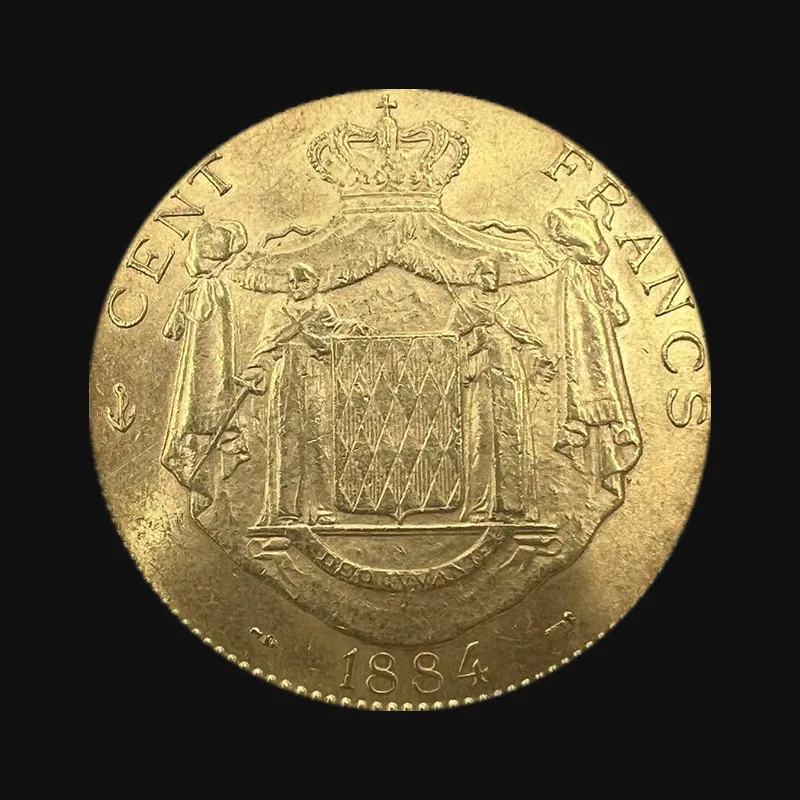
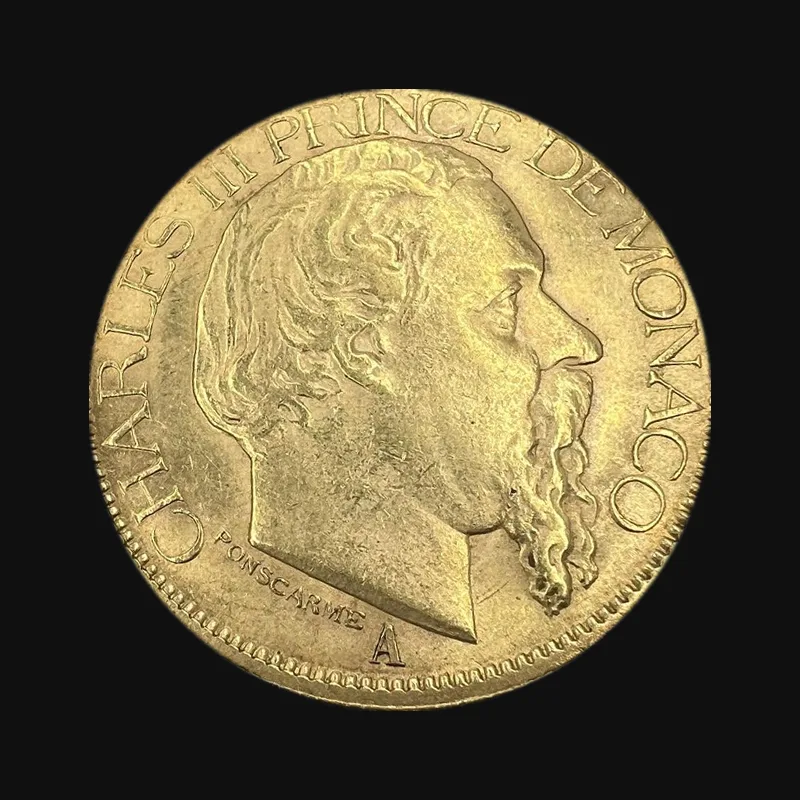
The 1974 gold 5 francs: essai or piedfort?
Rainier III's 5 francs never circulated in gold: from 1971 to 1995 it is a 10 g, 29 mm nickel-plated copper-nickel coin bearing the crowned double-R monogram. In 1974, however, the Monnaie de Paris struck collector versions with the same design and date.
The gold essai weighs 19.58 g of 920‰ gold, carries the word ESSAI in front of the prince's face and has a striated edge; CGB gives 1,000 pieces. The gold piedfort keeps the 29 mm diameter but doubles the thickness: 39.6 g, plain edge, 250 pieces. There is also a silver essai (11.6 g) and a silver piedfort (23.2 g), the latter at 250 pieces according to Collector's Key, which credits the design to Raymond Joly.
To find out which one you have, weigh the coin on a scale reading to a tenth of a gram, then check the edge and look for the word ESSAI. A golden-looking 10 g 5 francs is just a circulation coin, possibly plated.
A currency modelled on the French franc
Monaco never set a separate rate for its franc: a Monegasque coin was worth a French coin of the same amount, and according to the sources both circulated on each side of the border. The customs union dates back to an 1865 convention, redrawn in 1912 and then replaced by the convention of 18 May 1963, applied from 1 September 1963.
Two other texts frame the currency: in 1938, a convention on the consequences of the franc's devaluation; in 1945, another on exchange control. When Paris launched the new franc in 1960, the principality adopted the same conversion rate, 100 old francs for 1 new.
Because striking fell to the Monnaie de Paris, Monegasque coins often borrow metal, weight and diameter from contemporary French coins. In 1999 Monaco's franc in turn became a division of the euro, before giving way to euro coins in 2002.
From the prince's name to the tiny symbol by the date
Step one, the legend. The name LOUIS II limits the coin to 1945-1947; at that time the 1 and 2 francs are aluminium-bronze, the 5 francs aluminium and the 10 and 20 francs copper-nickel. The name RAINIER III, who came to the throne in 1949, covers every strike from 1950 to 2000.
Step two, the signature, often tiny beneath the bust. Maubert signs in 1945, Turin from 1946 to 1960, Cochet the 1982 100 francs and R.B. Baron the bimetallic 10 francs from 1989: this often dates a coin more safely than style does.
Step three, the marks. No mint letter, since everything comes from Paris, but small symbols frequently surround the date, as on French francs: Raymond Joly's owl (1958-1974), Émile Rousseau's dolphin (1974-1994), Pierre Rodier's bee (1994-2001). The value itself appears in full or shortened to “F”.
Other strikes in silver and gold
In silver, two types genuinely circulated. First the 1960 and 1966 5 francs, whose portrait is signed by Turin; it holds 10.02 g of fine metal, as much as the French Semeuse. The 1966 10 francs, signed by Maurice Delannoy, is a broad 37 mm coin at 900‰: Prince Charles III appears alongside the years of his reign, 1856-1889, and Rainier III's arms fill the other side. Lastly, the 1982 silver 100 francs, after Robert Cochet, pairs Rainier III with his son Albert.
For this period, gold only shows up on collector strikes: besides the 1974 5 francs, the four 1950 values (10 to 100 francs) gathered in a case as gold essais, and the 1982 100 francs as a gold piedfort, 250 pieces. Monegasque essais are plentiful and often sold cased: the 1966 10 francs had 1,000 on proof flans, the 1950 100 francs counts 1,700 in aluminium-bronze, and 500 cases bring together the 1960 1 and 5 francs.
For French silver of the same era, see the silver 5 francs ecu page, which covers the older crown-sized pieces.
What can pass for a Monegasque franc
A French coin of the same size. The silver Semeuse 5 francs shares fineness, weight and diameter with Rainier III's 5 francs; the Génie de la Bastille 10 francs has the same alloy and 6.5 g as Monaco's bimetallic 10 francs, at an almost identical diameter. Only design and legend tell them apart.
Rainier III's two old 100 francs. 30 mm and 12 g in 1950, 24 mm and 6 g in 1956.
A medal. Princely profiles decorate many Monegasque medals; with no franc value and no DEO JUVANTE motto, they are not money.
Monaco's euros. Struck since 2001, they form a separate series outside the scope of this page.
Condition and storage
The 1945 aluminium scratches and bends at the slightest knock. On the portraits, wear first hits the prince's hair and ear; on the reverse, the crown and the folds of the mantle. Essais and piedforts should keep the brilliance of their strike: a fingerprint or a rub shows quickly on polished gold.
Keep cases, sealed bags and issue paperwork, which document where a collector strike came from, and never clean a coin. A numismatist can look at it through our coin identification page.