Following the portrait: from the child king to Warin's head
Louis XIII came to the throne aged eight in 1610 and died in 1643. His doubles show him growing up, and that is the first clue when the date is worn.
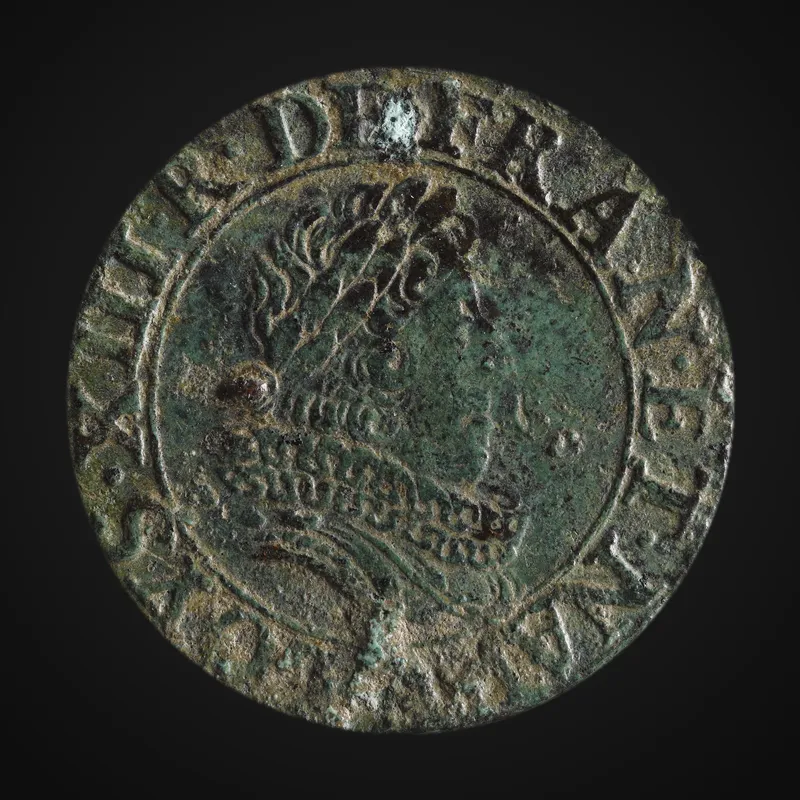
The first types, from 1611, carry a childish bust: a round face, a laurel wreath, armour and either a small flat collar or a large ruff. Then come the juvenile busts of the 1620s, with a turned-down collar or a finer ruff; the face grows longer. At the end of the 1630s the adult king appears, still facing right, draped and cuirassed.
The last type breaks with all this. In 1642-1643 the bare laureate head by Jean Warin faces left, with no ruff, and the legend switches to Latin: “LVD. XIII. D. G. FR. ET. NAV. REX”. A double with the king facing left and a Latin legend therefore almost always dates from those two years.
Within one type, the catalogues still separate varieties of bust, punctuation or the mark placed in the reverse legend.
Doubles and deniers: weight, mints and manufacture
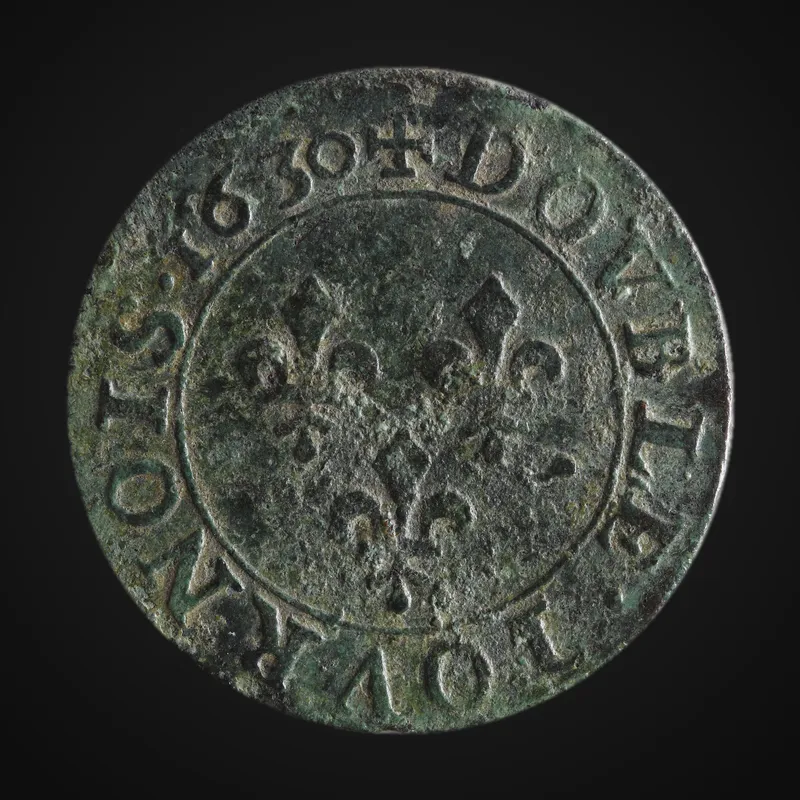
The statutory weight of the double was just over 3.1 g, but real coins stray a long way from it: the Musée Carnavalet holds doubles from 2.22 g to 3.36 g, and a dealer listing describes one of 2.04 g. A light double is not suspicious for that reason alone. The denier tournois, half a double, is smaller and thinner, around 1.7 g for 17 mm; its reverse shows two lilies instead of three, with its denomination.
Most of these coins were struck with the hammer on blanks that are often short or irregular: part of the legend may be missing from the start, and off-centre strikes are common. The 1611 doubles of Paris, however, came from the Moulin du Louvre, where coins were struck by machine, and the Warin type also seems to be machine-made.
The number of mints is striking: Paris, Lyon, Bordeaux, Poitiers, Tours, La Rochelle, Aix, as well as private mints such as Chappes in Champagne. The crown handed production to contractors, and the regency of Marie de' Medici multiplied these contracts. Droulers puts the output at about 600 million doubles.
Not to be confused with: princely doubles and imitations
The royal double was copied by princes who struck coins on their own lands, on the edges of the kingdom. Their pieces keep the size, the copper and often the legend “DOVBLE TOVRNOIS”, which let them mix with the king's doubles.
- Dombes: at Trévoux, Gaston d'Orléans, brother of Louis XIII, had doubles struck with his bust around 1638-1640; the lilies on the reverse carry the Orléans label.
- Sedan and Bouillon: Frédéric-Maurice de La Tour d'Auvergne signs “F. M. D. L. TOVR. DVC. D. BVILLON”; his reverses show a small tower, then the words “DOVBLE DE SEDAN”. Sedan was joined to the kingdom in 1642.
- Château-Regnault: François de Bourbon, Prince of Conti, who died in 1614, had his name engraved with three differenced lilies.
- Arches-Charleville: Charles de Gonzague also struck doubles in his own name.
Others are known for Orange, Monaco, Boisbelle (Sully) and Phalsbourg. The rule is simple: read the obverse legend. If it does not give “LOYS” or “LOVIS XIII”, King of France and Navarre, the coin is not royal. The very similar doubles of Henri IV read “HENRI IIII”. None of the sources consulted reliably describes contemporary forgeries; a coin of unusual size or design deserves a closer look.
Out of the ground: wear, corrosion and reading the date
Louis XIII doubles often turn up in fields and gardens. They circulated for a long time and then spent centuries in the soil: a well-preserved example is the exception.
To judge wear, look at the laurel wreath and the ruff on the obverse: on a double in good condition the leaves can be counted and the folds of the collar remain visible. On the reverse, the lower fleur-de-lis and the centre of the two upper lilies flatten first. The date, set in the reverse legend, is often the first thing to go, partly because it sometimes falls off the blank.
The soil adds its own damage. A smooth, stable brown or dark green crust is part of the coin. Pale green powdery spots, or a surface that flakes, point to corrosion that is still active. Dry the coin, keep it away from damp and do not scrape it: chemicals and brushes strip away the last of the relief.
History: from Henri III's copper to the liard
Until the 16th century the double tournois was a billon coin, copper alloyed with a little silver. Under Henri III, in the late 1570s, the monarchy struck deniers and doubles in pure copper for the first time, partly with copper from Sweden. The coin no longer held any precious metal: it circulated because the king set its denomination.
Henri IV continued these issues, and Louis XIII took them to an almost industrial scale. The flood of doubles, struck by contractors and imitated by neighbouring princes, ended up clogging circulation. Royal doubles stopped early in the reign of Louis XIV, after small issues in 1644 and 1647, and the three-denier liard took over; part of the liards were made from withdrawn doubles.
Jean Warin, who engraved the laureate head of 1642-1643, also engraved the first louis d'or at the same period.