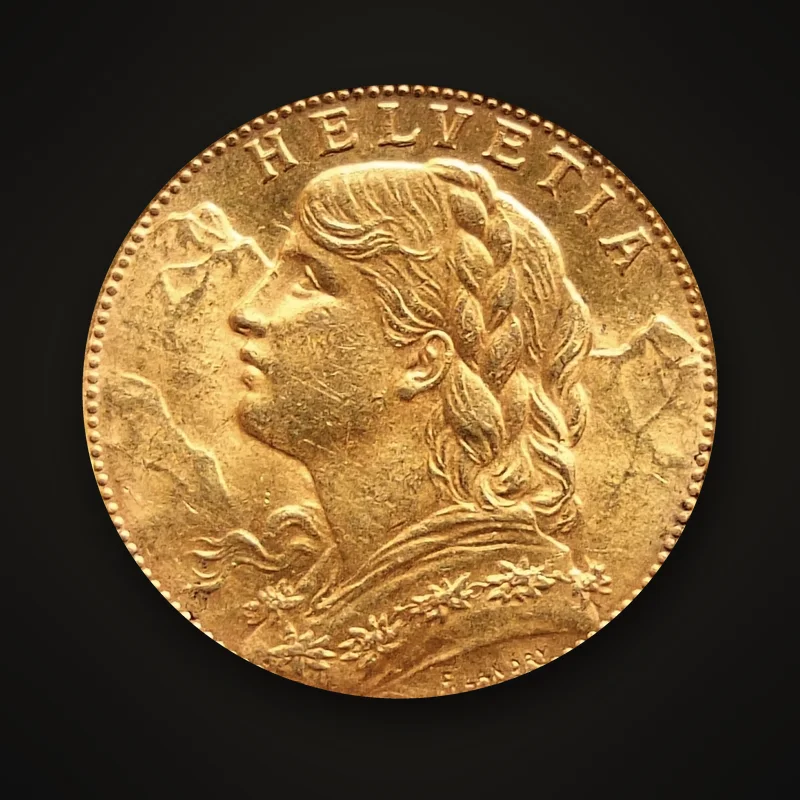
Obverse
Female bust facing left, hair tied in a plait, bodice decorated with a garland of edelweiss, against a background of mountains. At the top, “HELVETIA”; at the bottom right, the signature “F. LANDRY”.
Written by the Maison Or & Bijoux Mougins team · updated
| Country | Switzerland |
|---|---|
| Metal | Gold, 900‰ fine (10% copper) |
| Weight | 6.45 g (6.4516 g) |
| Fine gold | 5.806 g |
| Diameter | 21 mm |
| Thickness | 1.25 to 1.3 mm depending on the source |
| Years struck | 1897-1916, 1922, 1925-1927, 1930, 1935; restrikes L 1935 B (1945-1947), 1947 and 1949 |
| Mint | Bern (B) |
| Engraver | Fritz-Ulysse Landry |
| Edge | 22 raised stars, then “AD LEGEM ANNI MCMXXXI” in 1947 and 1949 |
| References | KM 35.1 (star edge) and KM 35.2 (inscribed edge) |
A young woman with plaited hair, in profile in front of an Alpine range, and the word “HELVETIA” above: this is the Vreneli, the Swiss 20 francs gold coin. Struck in Bern from 1897, then again in very large numbers after the Second World War, it totals nearly 59 million examples. That is why it so often keeps company with napoléons in family boxes.
Female bust facing left, hair tied in a plait, bodice decorated with a garland of edelweiss, against a background of mountains. At the top, “HELVETIA”; at the bottom right, the signature “F. LANDRY”.
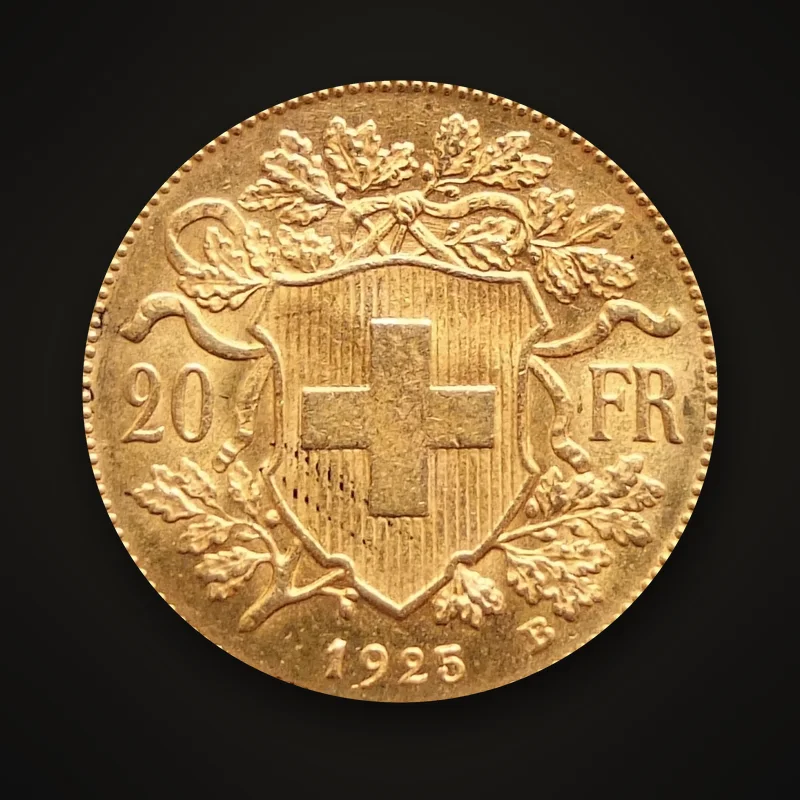
Shield with the Swiss cross resting on an oak branch and flanked by “20 FR.”, with the year and the letter “B” of the Bern mint. Post-war restrikes read “L 1935 B”.
First check whether the date is preceded by an L, then look at the edge. The last three rows, L 1935 B, 1947 and 1949, account on their own for nearly 40 million coins. The lowest mintages of the regular striking are in 1926, then 1904, 1905 and 1906.
| Year | Mint | Mintage | Remarks |
|---|---|---|---|
| 1897 | B | 12 | Pattern with a forelock (“Stirnlocke”), edge “DOMINUS PROVIDEBIT”. |
| 1897 | B | 29 | Struck in gold from the Gondo mine (Valais). |
| 1897 | B | 400,000 | First year of the regular striking. |
| 1903 | B | 200,000 | Uncommon date. |
| 1904 | B | 100,000 | Low mintage. |
| 1905 | B | 100,000 | Low mintage. |
| 1906 | B | 100,000 | Low mintage. |
| 1907 | B | 150,000 | Uncommon. |
| 1913 | B | 700,000 | Common. |
| 1915 | B | 750,000 | Highest pre-war mintage. |
| 1916 | B | 300,000 | Last date before the 1917-1921 pause. |
| 1922 | B | 2,783,678 | Common. |
| 1925 | B | 400,000 | Year of the 100 francs Vreneli. |
| 1926 | B | 50,000 | Lowest mintage of the regular striking. |
| 1927 | B | 5,015,000 | Very common. |
| 1930 | B | 3,371,764 | Common. |
| 1935 | B | 175,000 | Original striking, without L. |
| L 1935 B | B | 20,008,813 | Restrike from 1945 to 1947, L for “lingot” (ingot). |
| 1947 | B | 9,200,000 | Edge “AD LEGEM ANNI MCMXXXI”. |
| 1949 | B | 10,000,000 | Last striking, same edge. |
Figures from the Lugdunum Numismatik table. The total of about 58.6 million agrees with the Historical Dictionary of Switzerland and Wikipedia; 1926, 1935 and L 1935 B are confirmed by Wikipedia (en). The years not listed (1898-1902, 1908-1912, 1914) all exceed 300,000 coins.
1897-1916: a circulating coin. The federal law of 6 January 1896 paved the way for a new 20 francs to replace the Helvetia with a diadem. Switzerland was then part of the Latin Monetary Union: its gold followed the same standard as that of France, Belgium and Italy. The coin was struck every year until 1916. The public nicknamed it “Vreneli”, a Swiss German diminutive of Verena. Who sat for Landry? Two names are put forward, Rosa Tännler and Françoise Kramer-Egli, without final proof.
1922-1935: isolated issues. After a pause, Bern struck only a handful of dates: 1922, 1925 to 1927, 1930, 1935. At the end of September 1936, when Switzerland devalued its franc, the Vreneli ceased to be legal tender.
1945-1949: the restrikes. The Federal Mint nevertheless took up the die again after the war, first keeping the date 1935 preceded by an L, then with the dates 1947 and 1949. These coins never served for payments. They represent about two thirds of all known Vreneli, which explains their presence in so many hoards.
Turn the coin on its edge before even reading the date. Raised stars: struck from 1897 to 1935, or an L 1935 B restrike. A Latin inscription: 1947 or 1949. If a coin dated 1910 or 1927 shows an inscribed edge, or a 1949 shows stars alone, something is wrong.
Then go back to the reverse. The 1935 date exists in two forms. With no letter before the date, it is the original striking, 175,000 coins. With an L, it is the 1945-1947 restrike, at more than 20 million examples. A loupe is enough to tell them apart.
The years to watch in the regular striking are 1926 (50,000 coins), then 1904, 1905 and 1906 (100,000 each), 1907 and 1903. The case of 1926 is telling: its mintage is the lowest, but a good share of the coins seems to have been kept, so it turns up more often than this figure suggests.
That leaves the 1897 coins that few collections will ever see: twelve patterns with a lock of hair on the forehead, removed because it was judged too frivolous, and 29 coins struck from Valais gold mined at Gondo.
The Vreneli is struck in low relief, so wear shows quickly. Place the coin under a lamp, slightly tilted, and follow these points in order.
Coins from before 1916 were used: they show real wear and often traces of a jewellery mount, a ring soldered or set on the edge. Post-war restrikes are usually little worn, but marked with small knocks in the field, caused by coins rubbing against each other in bags. A satin lustre that turns as you tilt the coin indicates an example that never circulated. Never rub a Vreneli: the guides to cleaning coins and to coin grades (in French) explain why.
Copies. Almost every year has been imitated, not only the rare ones. Some copies are struck in gold and reach the correct weight. Faults noted on analysed examples: a thickness or weight slightly off standard, silver in the alloy whereas the original contains none, badly drawn letters in “HELVETIA”, a misshapen B, blurred numerals and irregular edge stars.
Medals. Modern tokens reproduce Landry's portrait. They usually lack the “20 FR.” mark, the letter B or the original edge: they are not coins.
Similar coins.
The Vreneli has no historical link of its own with Mougins or the Côte d'Azur. Coins struck before 1914 followed the standard of the Latin Monetary Union, to which Switzerland belonged until its dissolution in 1927, and the 1865 convention made members' gold acceptable in French public treasuries. But it is above all the post-war restrikes, L 1935 B, 1947 and 1949, that turn up in estates from Mougins and the Grasse area, most often kept together with napoléons and 20 lire.
No. The Vreneli lost its legal tender status in 1936. Coins dated 1947 and 1949, like the L 1935 B, were struck after the war and never circulated as a means of payment.
On the reverse, next to the date, below the shield. It stands for the Bern mint, the only one to have struck this coin. On the restrikes, it follows the date: “L 1935 B”.
5.806 g of pure gold, for a total weight of 6.45 g at 900 thousandths. That is exactly the same amount as in a French napoléon.
Its mintage is the lowest of the regular striking, 50,000 coins, but many were kept. It is still sought after, especially in fine condition. For a particular coin, a free valuation makes it possible to check its authenticity.