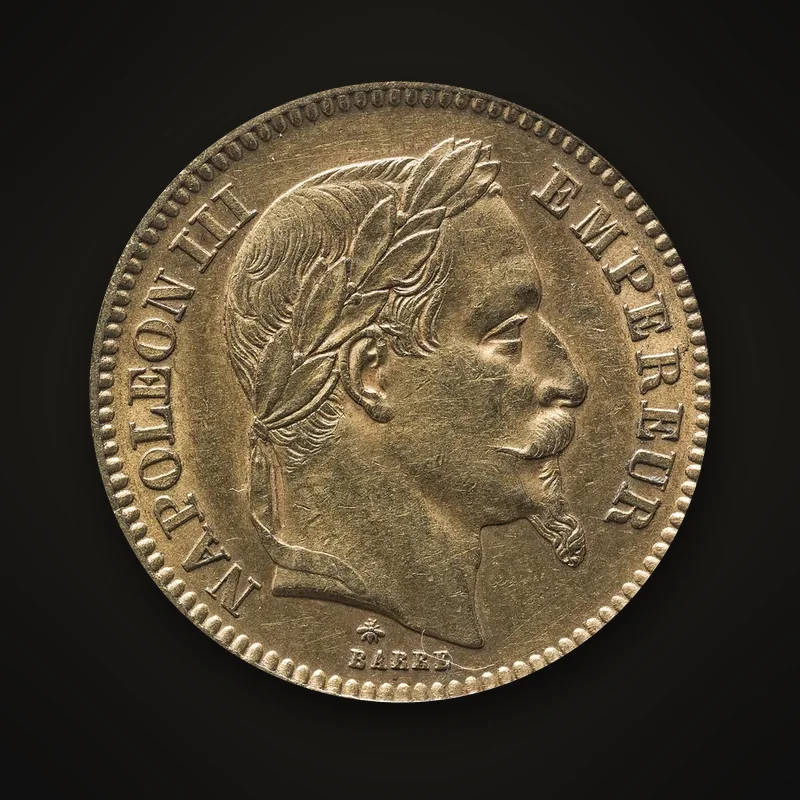
Obverse
Profile of Napoleon III facing right, without a wreath from 1853 to 1860, crowned with laurel from 1861 to 1870. The signature BARRE can be read below the neck. Circular legend: “NAPOLEON III EMPEREUR”.
Written by the Maison Or & Bijoux Mougins team · updated
| Country | France |
|---|---|
| Metal | Gold, 900‰ fine |
| Weight | 6.45 g |
| Fine gold | 5.806 g |
| Diameter | 21 mm |
| Years struck | 1853-1860 (bare head), 1861-1870 (laureate head) |
| Mints | A (Paris), BB, D (Lyon, in 1855 only) |
| Total mintage | 146,544,669 (bare head), about 85.5 million (laureate head) |
| References | F.531 (bare head), F.532 (laureate head) |
A small 21 mm gold coin bearing the bearded profile of the Emperor, the 20 francs Napoleon III is the “napoléon” most often found in drawers. More than 230 million were struck between 1853 and 1870. With a loupe, a few details are enough to tell which type, which mint and which variety you have.
Profile of Napoleon III facing right, without a wreath from 1853 to 1860, crowned with laurel from 1861 to 1870. The signature BARRE can be read below the neck. Circular legend: “NAPOLEON III EMPEREUR”.
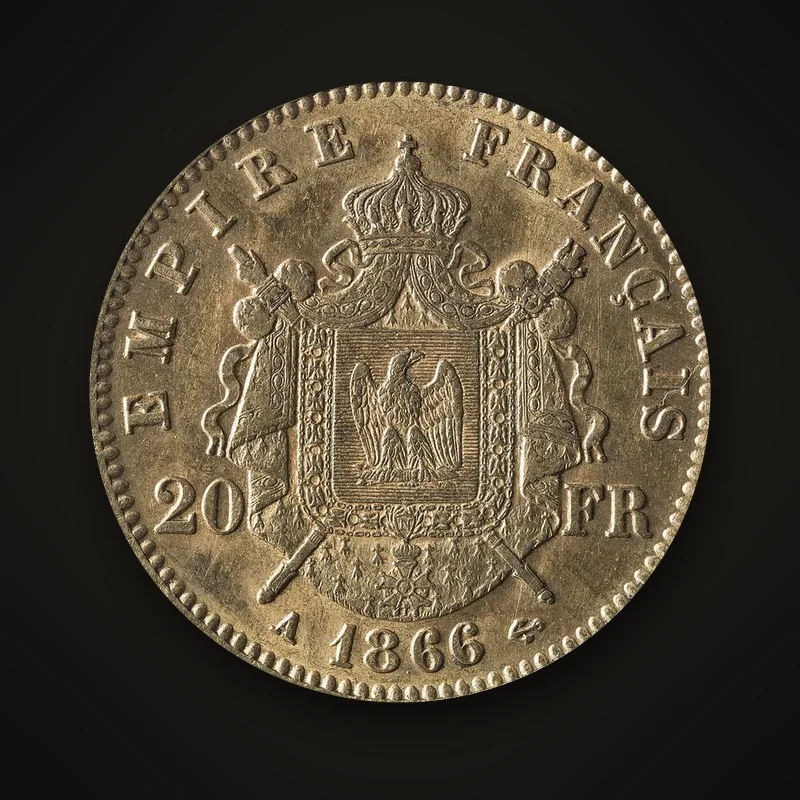
First type: the inscription “20 FRANCS” and the year in the centre of a wreath of two tied laurel branches, legend “EMPIRE FRANÇAIS”, mint mark below the knot. Second type: imperial coat of arms (eagle on a thunderbolt, within the collar of the Legion of Honour, set on a mantle topped by a crown), “20” and “FR” on either side, legend “EMPIRE FRANÇAIS”, date and mint mark below the mantle.
Each row pairs a year with a mint. The large figures explain why so many coins are still around; the small ones point to the combinations collectors look for. After the year and the letter, the Remarks column gives the privy marks or varieties that can separate two coins of the same date.
| Year | Mint | Mintage | Remarks |
|---|---|---|---|
| 1853 | A | 5,729,471 | First year of the bare head |
| 1854 | A | 23,485,957 | Highest mintage of the type |
| 1855 | A | 16,595,397 | Dog's head and hand, or hand and anchor |
| 1855 | BB (Strasbourg) | 1,759,701 | Dog's head and bee, or bee and anchor; the dog's head is the less common |
| 1855 | D | 363,017 | Lyon's only year, lion varieties; lowest mintage of the type |
| 1856 | BB | 1,125,030 | Lowest BB mintage of the bare head; dog's head variety sought after |
| 1857 | A | 19,193,214 | No BB striking recorded this year |
| 1858 | BB | 2,016,653 | Figure disputed, see the note |
| 1859 | BB | 5,870,646 | Common |
| 1860 | A | 10,219,917 | Exists with 6 re-engraved over 5 |
| 1860 | BB | 5,726,718 | Also exists with 6 over 5 |
| 1861 | A | 2,607,054 | First year of the laureate head |
| 1861 | BB | 1,423,199 | Lowest BB mintage of the laureate head |
| 1862 | A | 4,825,915 | Exists with a “large A” |
| 1864 | BB | 3,323,192 | Small BB and large BB |
| 1865 | A | 2,951,440 | Modest mintage for Paris |
| 1866 | BB | 6,978,507 | One variety with a reeded edge, rare |
| 1867 | A | 2,923,024 | Modest mintage for Paris |
| 1867 | BB | 4,516,490 | Small BB and large BB |
| 1868 | A | 9,281,061 | Highest mintage of the laureate head |
| 1869 | BB | 7,316,553 | Small BB and large BB; figure disputed, see the note |
| 1870 | A | 864,873 | Lowest mintage of the laureate head |
| 1870 | BB | 1,852,567 | Last BB year for this type |
Mintages taken from the BDOR and Abacor tables, which agree; varieties after the Le Franc catalogue (F.531 and F.532). A yearly figure covers all the varieties of that year. Discrepancies: Numista gives 1,817,394 for 1855 BB, CGB 2,067,740 for 1858 BB, and CGB attributes 864,873 coins to a variety of 1869 BB. Years not listed have intermediate mintages.
The first glance goes to the Emperor's head. Without a wreath, the coin belongs to the first type, struck from 1853 to 1860; its reverse shows “20 FRANCS” within a laurel wreath. With a laurel wreath in the hair, it is the second type, from 1861 to 1870, with the imperial coat of arms on the reverse.
These two types frame the history of the Second Empire. Proclaimed in December 1852, it struck its first gold coin in 1853. Gold from California and Australia was then pouring into Europe: in Paris, every year from 1854 to 1859 exceeded 16 million coins. In 1865, France signed the Latin Monetary Union convention with Belgium, Italy and Switzerland, making their gold coins interchangeable. Imperial striking ended with the defeat at Sedan in September 1870.
The nickname “napoléon” is older: it comes from the 20 francs of Napoleon I, struck to the standard of 6.45 g of gold at 900 thousandths set by the law of 7 Germinal Year XI (1803). Napoleon III coins circulated until 1914, which explains why they are so often worn.
Turn the coin over. On the first type, the mint mark hides below the knot tying the two branches; on the second, it sits at the bottom, next to the date. A stands for Paris, which struck most of the coins, and D for Lyon, which produced this napoléon only in 1855. The third letter, doubled, belongs to the only other mint, shown in the table.
On either side of the letter are two symbols the size of a pinhead: the privy marks. One refers to the Chief Engraver, the other to the mint director. On the first type, the dog's head stands for Jacques-Jean Barre and the anchor for his son Albert-Désiré, in office from 1855. The hand goes with Paris, the lion with Lyon, the bee with the third mint.
In 1855 the two engravers succeeded each other, so the same date exists with either the dog's head or the anchor, the first being the scarcer. On the second type, also look at the size of the letter itself: 1862 exists with a “large A”. A ×10 loupe and raking light are enough.
Most napoléons found are heavily struck dates: 1854, 1855, 1857 or 1859 in Paris for the first type, 1866 to 1868 for the second. A few cases nonetheless deserve a closer look.
The other markers (low mintages at each mint, small and large letters) are in the table.
Forgers have been interested in this coin for as long as it has existed. Platinum fakes date from the Second Empire itself: platinum was then cheaper than gold and heavier, which made it possible to fool the scales. They imitate dates of both types, for example 1858 A, or 1865 and 1867 with the letter of the third mint. They give themselves away by their grey colour, visible as soon as the surface is worn or scratched. Now witnesses of their period, they interest some collectors today.
Modern gold fakes, sometimes of the correct fineness, imitate a coin in high demand. Warning signs: soft relief, hair without detail, badly aligned edge lettering, a weight slightly off standard. Three simple checks: the scales (6.45 g, a few hundredths less for a worn coin), the diameter (21 mm) and the edge, which should be crisp and raised.
If in doubt, do not use acid and do not scratch the coin.
On the first type, look first at the hair above the ear and on the temple, then at the cheekbone and the tip of the goatee. When the locks remain separate, the coin is at least Very Fine (French grade TTB); when the hair has become a smooth surface, it drops to Fine (TB). On the reverse, follow the veins of the leaves and the knot of the ribbon.
On the second type, the laurel wreath is the indicator: its veins disappear quickly, then the leaves merge into the hair. On the reverse, the eagle, the thunderbolt and the very fine links of the collar wear before the folds of the mantle.
Family pieces are generally Fine or Very Fine. An Extremely Fine coin (SUP) keeps its original lustre in the recesses, around the letters. Never rub a gold coin to make it shine: the fine scratches that result take away most of its collector interest.
The reign of Napoleon III changed the map of the area. Before 1860, Mougins and the rest of the arrondissement of Grasse belonged to the Var department, while the County of Nice, on the other side of the river, belonged to the Kingdom of Sardinia. After the County was united with France in 1860, the law of 23 June 1860 created the Alpes-Maritimes department by joining the former County and the arrondissement of Grasse. Since 1816 the Sardinian lira had followed the weight and fineness of the franc, so families around Grasse often kept napoléons alongside Sardinian or Italian 20 lire gold coins.
Between 1861 and 1870. The laureate head replaced the bare head in 1861, and striking stopped with the fall of the Empire in September 1870.
Always on the reverse. On the bare head, below the ribbon knot tying the two laurel branches; on the laureate head, at the bottom, right next to the date. A loupe is often needed on a worn coin.
No, but it follows the same standard (6.45 g of gold at 900‰, 21 mm). The Latin Monetary Union countries struck coins with the same specifications, each with its own design.
Note the year, the mint mark and, if possible, the two small symbols around it, then compare them with the table. Condition matters as much as the date. A numismatist can carry out this check with you during a free assessment at the shop.