Three clues, read in order
Hold the coin under a lamp with a 5× or 10× loupe and always work in the same order.
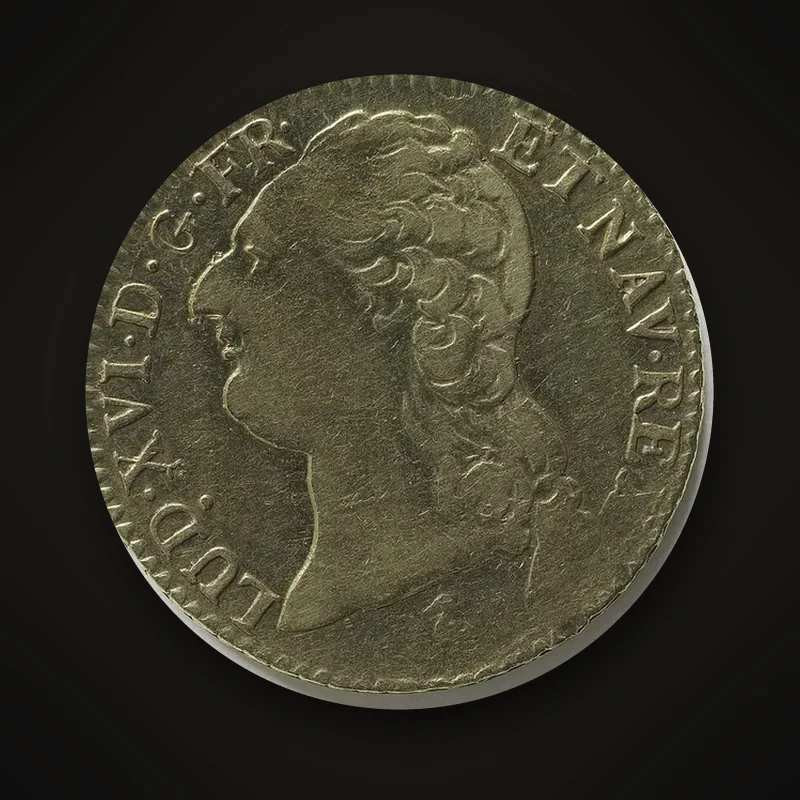
The king first. The numeral after LVD (or LUD) in the obverse legend tells you who he is: XIII, XIIII (sometimes XIV), XV or XVI. The direction of the profile helps when the legend is worn: facing right up to Louis XIV, facing left afterwards.
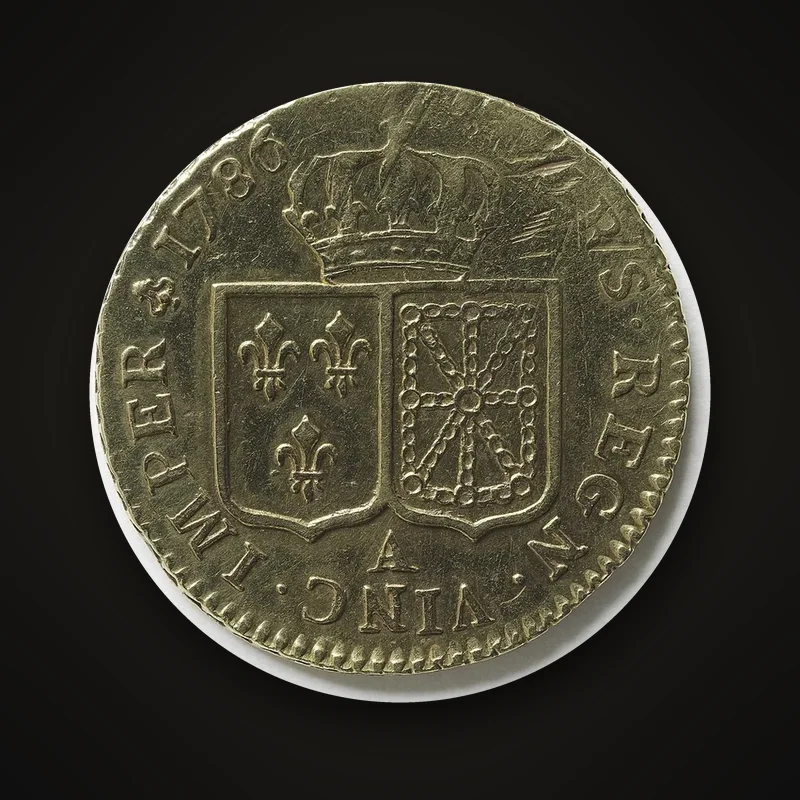
Then the reverse. A cross of Ls, a sun at the centre, two oval shields that look like a pair of spectacles, two square shields side by side: each design belongs to a short period, often only a few years. The table above lists them in order.
Finally, the mint and the date. The letter identifies the town where the coin was struck: A for Paris, D for Lyon, & for Aix-en-Provence, W for Lille. Depending on the type, it sits below the bust, at the centre of the cross or below the shields. The date, in Arabic numerals, is close by.
Why two louis do not weigh the same
The louis never had a single weight. When it was created under Louis XIII, it held about 6.75 g of 22-carat gold. It was struck on a screw press, which produced well-rounded blanks, so a coin clipped at the edge is easy to spot.
The first break came in 1709. To pay for the war, the crown had the coinage melted down and the new louis au soleil rose to 8.158 g. The following decade was unsettled: under the Regency and during John Law's system, the weight climbed to 12.235 g with the Noailles louis, came back down to about 9.79 g, then fell to 6.525 g with the mirliton of 1723.
The edict of January 1726 restored the louis to 8.158 g. This standard lasted almost sixty years, through the louis aux lunettes, au bandeau, à la vieille tête and the first types of Louis XVI. The last reform, in 1785, lowered it to 7.649 g; this is the louis with square shields.
In practice, a coin that is clearly off the weight of its type is not necessarily false, but it has a history. Wear, clipping, a filled hole or fraudulent manufacture: you need to find out which.
Half louis, louis or double louis?
The three sizes share the same design. Only the diameter and the weight tell them apart, which is why the scale matters.
The half louis weighs half the louis of its time: about 3.38 g until 1709, around 4.08 g for the sun, spectacles and headband types. Its diameter is around 20 mm.
The double louis was not struck for every series. Numista records it under Louis XIII, for the Louis XIV types with the shield, four Ls, insignia and sun, for the mirliton, headband and old head of Louis XV, and for the two main types of Louis XVI. The double louis with square shields measures about 28 mm.
Separately, the Paris Mint produced multiples of 4, 8 and 10 louis in 1640, intended for gifts and ceremonies. They were not used in everyday payments.
The same reasoning applies to each size: king, reverse, letter, date, then a weight check.
Jewellery, restrikes or copies: cases that need a second look
Traces of an earlier design. Between 1690 and the early 1700s, the mints often restruck louis already in circulation with a new type instead of melting them down: these are the réformations. Ghost letters or outlines then show beneath the main design. This is a feature of the period, recorded in the catalogues, not recent work.
Varieties followed by collectors. The mirliton exists with short palms and with large palms; the Louis XIV louis with insignia is found with short or long hair.
Coins that went through the jeweller's. Many louis were set in a brooch or hung from a chain. A torn-off loop, solder on the edge or a filled hole greatly reduces their interest to collectors, without making them counterfeits.
Imitations. Copies exist in low-grade gold and in gilt metal. Check the weight to the hundredth of a gram, the diameter with callipers and the sharpness of the lettering, which is often soft on a copy.
A mix-up of words. Many families call the 19th-century 20 francs gold coins “louis”. A legend in French and a denomination in francs point to a napoléon, not a royal louis.
Where wear shows first
On the portrait side, look at the highest points: the hair above the ear, the laurel or the headband, the cheekbone. On the louis of Louis XV and Louis XVI, the curls merge into one another long before the profile flattens.
On the reverse, the crowns above the shields or the Ls are the best witness. Their pearls can be read one by one on a lightly worn coin; they form a smooth band on a louis that has circulated for a long time. The fleurs-de-lis on the shields also lose their edges.
A field covered in fine parallel scratches is a sign of rubbing or cleaning, which lowers the grade. A milled edge that is flattened in places suggests the coin was once mounted. Never clean a gold coin: show it as it is to a numismatist.