Sorting a hoard of foreign 20 francs
A box found in a house in the hills behind the coast often mixes French napoléons with a few foreign gold coins of the same size. To separate them without damaging anything, work in this order.
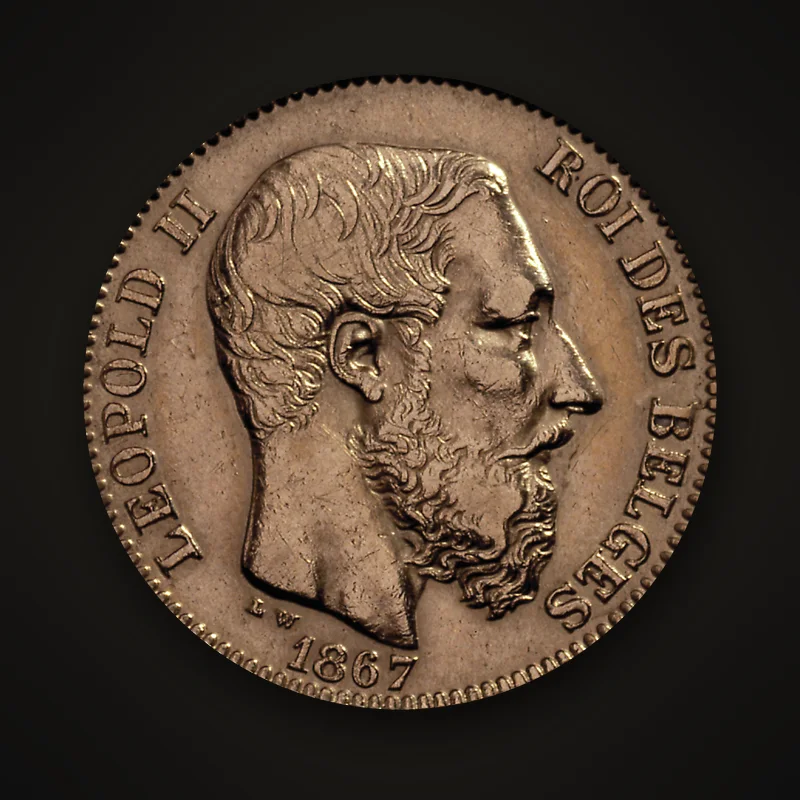
- Read the obverse legend. “ROI DES BELGES” or “KONING DER BELGEN”: Belgium. “VITTORIO EMANUELE II” or “RE D'ITALIA”: Italy. “CONFOEDERATIO HELVETICA”: Switzerland. “REPUBLIQUE FRANÇAISE”, “EMPIRE FRANÇAIS” or the name of a French king: a French coin.
- Name the sovereign. Leopold II and Umberto I make up the bulk of most hoards. A Leopold I, an Albert I or a Victor Emmanuel II is already out of the ordinary.
- Note the date, then, on Italian coins, the mint mark on the reverse.
- Weigh and measure: 6.45 g and 21 mm for all of them. Wear only removes a few hundredths of a gram.
Slip each coin into its own envelope, with a pencilled label: country, sovereign, year. This is enough to find the low-mintage dates in the table of dates, especially the Helvetia of 1887 and 1888 and the 20 lire struck in Rome under Victor Emmanuel II. Never rub a coin to read a date: a loupe and a low-angled lamp do better.
The 20 lire of the House of Savoy
Before he reigned over Italy, Victor Emmanuel II was King of Sardinia, a state whose capital was Turin. From 1816, this kingdom struck in Turin and Genoa a lira pegged to the franc, at the same weight and fineness. Its 20 lire from before 1861 therefore have the size of the Union coins, but their legend gives the title of King of Sardinia, without “REGNO D'ITALIA”.
In 1861, the Sardinian lira became the lira of the new Kingdom of Italy. Under Victor Emmanuel II, three mints produced 20 lire: Turin (T), Milan (M), then Rome (R) in the 1870s. In Turin and Milan, the letter comes with the initials “BN”, those of the Banca Nazionale. The reign totals about 11.7 million coins from 1861 to 1878, but the first Turin year left only a few thousand. Umberto I had about 8.8 million struck from 1879 to 1897, all in Rome; his years 1884, 1889, 1891, 1893 and 1897 are the least often seen.
Italians call these coins marenghi. The name goes back to the 20 francs gold coin issued by the Subalpine Republic to celebrate Bonaparte's victory at Marengo on 14 June 1800. It then spread to the 20 lire of the Union, just as “napoléon” did in France.
Under the loupe: varieties, wear and fakes
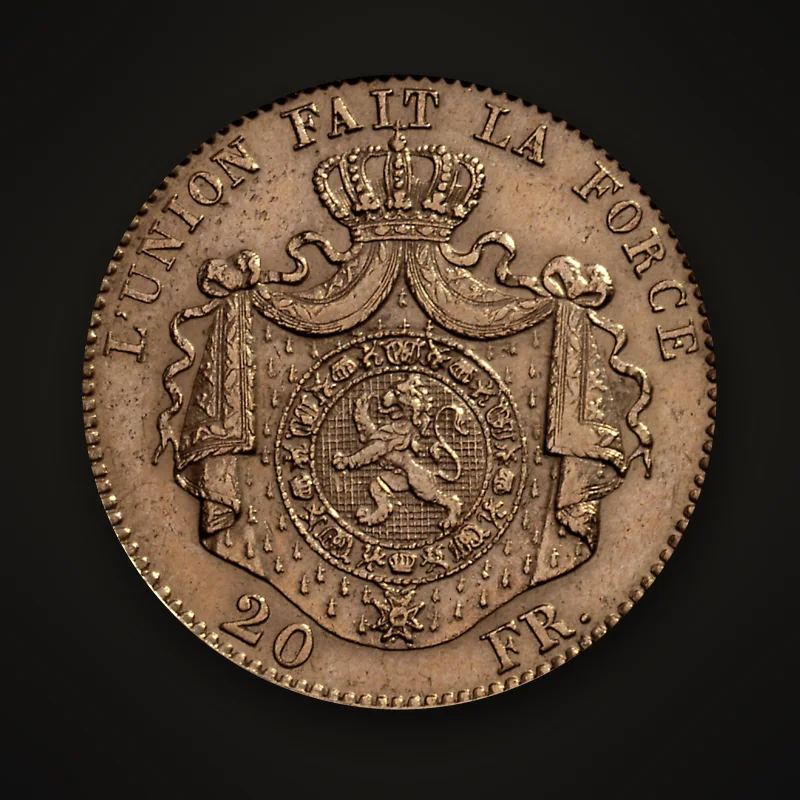
Belgian coins. The portrait of Leopold II first has a thick, coarsely detailed beard (1867-1870), then a finer one. Turn the coin on its vertical axis: depending on the date, the reverse appears upright or inverted, two positions recorded by the catalogues. One 1865 variety shows a misspelt signature, “L. WINNER”.
Helvetia. On the 1893 and 1895 dates, a tiny punch mark in the centre of the shield and a paler gold point to metal mined at Gondo, in the Valais: a few dozen coins in all.
Wear. The first areas to flatten are the beard and the hair above the ear of Leopold II, the moustache of the Italian kings, the hair and diadem of Helvetia. On the reverse, follow the manes of the Belgian lions, the cross and collar around the shield of Savoy, the leaves of the Swiss wreath. Solder or a ring mark on the edge reveals an old jewellery mount; fine parallel scratches, a cleaning. The grading scale is described in the guide to coin grades (in French).
Fakes. Rare Italian dates are the most copied, to the point that a large share of the examples offered are said to be counterfeits, some of them in gold. Check the weight, the diameter, the sharpness of the edge and the logic between sovereign, year and mint: an Umberto I marked T or M should raise doubts. The method is set out in the guide to spotting a fake coin (in French).
Same size, other coins
The 21 mm, 6.45 g module was taken up well beyond the four founding countries, hence frequent confusion.
- The Swiss Vreneli, from 1897: a young woman with plaited hair in front of mountain peaks, legend “HELVETIA”. It has its own page.
- The 20 lire of Victor Emmanuel III, struck in the 20th century, with another portrait and other reverses; some dates have tiny mintages.
- Gold coins of Monaco: Charles III, then Albert I, had 20 and 100 francs struck. The principality was linked to the Union by agreement, without being a member.
- Greek 20 drachmai, Greece having joined the Union in 1868, and Austro-Hungarian 8 florins, designed to match 20 francs.
- French 20 francs, recognisable by “EMPIRE FRANÇAIS”, “REPUBLIQUE FRANÇAISE” or the name of the sovereign: Napoleon I, Napoleon III, Ceres and others.
Key dates, from 1861 to 1927
- 1861: proclamation of the Kingdom of Italy; the first “REGNO D'ITALIA” 20 lire leave the Turin mint.
- 1865: Belgium issues the only 20 francs of Leopold I. On 23 December, in Paris, France, Belgium, Italy and Switzerland sign the convention of the Latin Monetary Union: the same weights and fineness for gold and silver, and members' gold coins accepted by the public treasuries of the others.
- 1867-1882: Leopold II has his 20 francs struck by the million.
- 1868: Greece joins.
- 1879-1897: 20 lire of Umberto I, all struck in Rome.
- 1883-1896: Switzerland strikes the Helvetia, before moving on to the Vreneli.
- 1914: Albert I has a single date struck. In France, the law of 5 August suspends the convertibility of banknotes into gold; gold disappears from payments and is kept at home.
- 1925-1927: Belgium withdraws from the convention at the end of 1925; the Union is dissolved on 1 January 1927.
For half a century, these coins therefore moved from one member country to another, before lying dormant in safes and drawers.