A king, a pair of scales or a merchant's name: sorting at a glance
These coppers are identified first by what they show. Three questions are enough to sort them.
Is there a king? A bareheaded bust of Louis XVI with “LOUIS XVI ROI DES FRANÇOIS” and a fasces on the reverse means a constitutional piece: 12 deniers (the sol) or 2 sols. The date appears twice, in plain figures below the bust and as a year of liberty on the reverse.
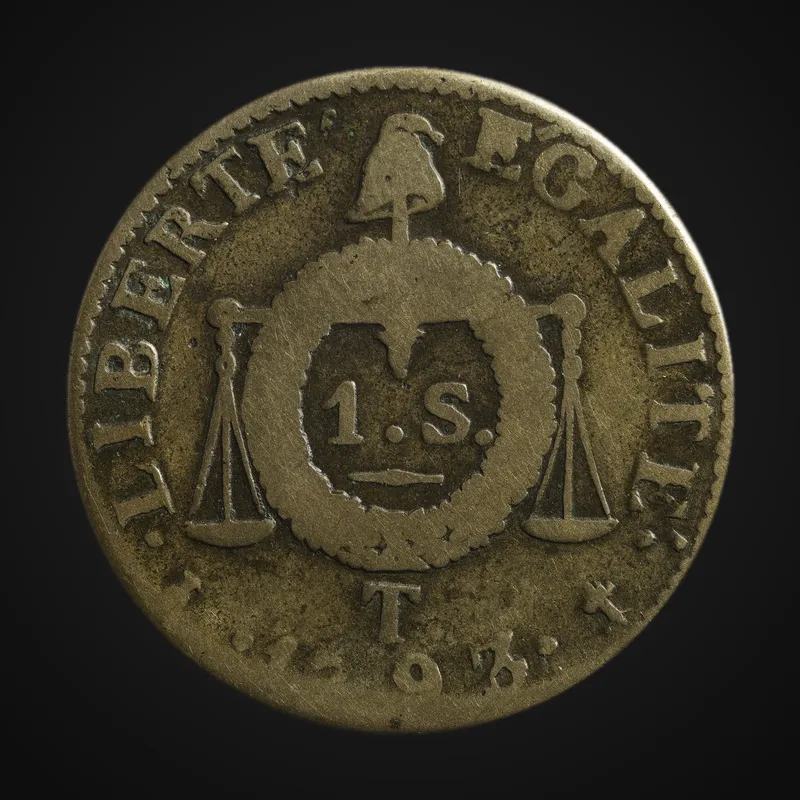
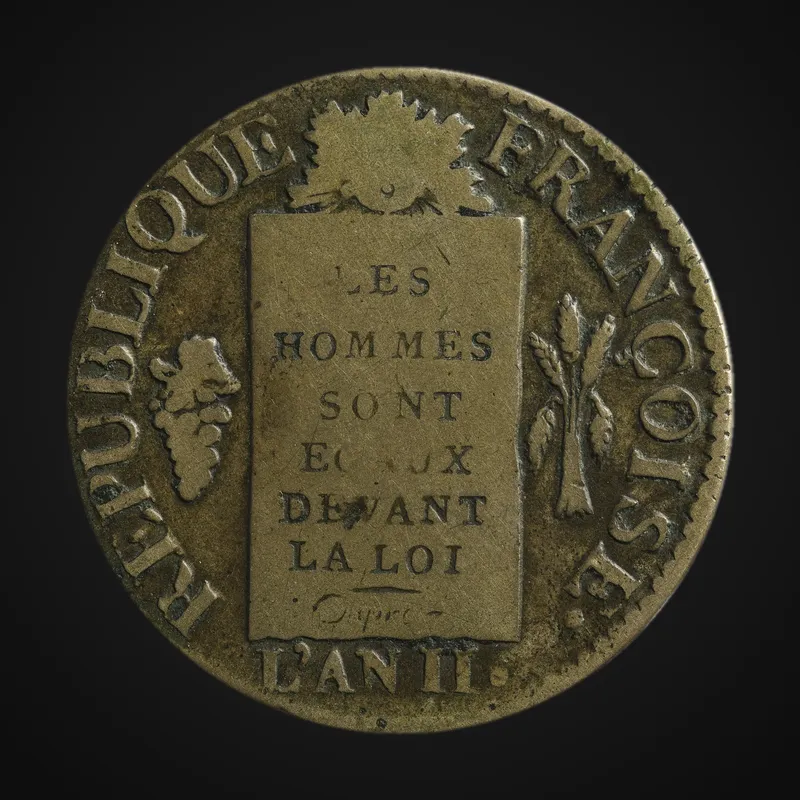
Is there a pair of scales? A tablet inscribed “LES HOMMES SONT EGAUX DEVANT LA LOI”, with scales carrying an oak wreath on the reverse, is the Year II type: half sol, sol or 2 sols depending on the figure in the wreath.
Is there a merchant's name? “MONNERON FRERES NEGOCIANS A PARIS” or the words “MEDAILLE DE CONFIANCE” mark a private piece, broader and better struck than the state coinage.
Size confirms it: about 29 mm for a sol, over 32 mm for a double sol, close to 40 mm for a Monneron 5 sols. Finally, look for the mint mark, below the bust or below the wreath. For silver struck at the same time, see the écu of Louis XVI.
The varieties that matter to a collector
The year of liberty. It counts from 1789: Year 3 is 1791, Year 4 is 1792 and Year 5 is 1793. The Musée Carnavalet holds a Paris double sol dated 1793 and “L'AN 5”, still with the king's bust in the year of his execution. Do not confuse it with the “L'AN II” of the balance-scale type, which counts the years of the Republic.
Spelling. Almost every mint wrote “FRANÇOIS”; one alone engraved “FRANÇAIS”, and its letter is given in the table. Local engravers also left mistakes: at Marseille, some 2 sols of 1792 read “LA LE LOI ROI” or “FRANÇIOS”.
Temporary mints. To keep up with demand, striking was handed to makeshift workshops and private blank makers. In Paris, the mint set up in the Barnabite convent used an A with a dot above it. Pau struck pieces specific to Béarn in 1793.
Metal. Catalogues separate bell metal from copper and brass, but the eye is easily misled. Weights vary widely: Coinvarieties records balance-scale sols from 11.27 g to 16.98 g against a legal 12.23 g. The balance-scale half sol, struck only at La Rochelle and Limoges, is the scarcest of the three sizes.
Restrikes, patterns and forgeries
Some coins of this period were restruck. Gadoury, quoted by Coinvarieties, mentions restrikes of the balance-scale 2 sols of Rouen, and La Rochelle half sols appear at auction described as restrikes. A coin that looks too perfect for a piece struck in a hurry therefore deserves a numismatist's opinion.
Patterns form a separate family. Dozens of trial pieces were struck in 1792 and 1793 while the Republic chose its emblems: “Règne de la loi” sols, 2 sols signed Bernier or Dupré, 5 décimes with the Régénération design. They differ from circulating coins by legends or designs absent from the table.
More curious still, the Musée Carnavalet holds a 1792 fasces double sol overstruck in 1831 with a head of Louis-Philippe: a reminder that these coppers long served as raw material.
Modern forgeries may also target the scarce types and Monneron pieces in fine condition. Be wary of a sol with soft relief, blurred lettering or a colour that is too even.
Wear and corrosion on these coppers
Coinvarieties notes that these hurriedly made types are rarely found better than Very Good. These coppers were only withdrawn in the mid-nineteenth century, so they spent more than fifty years in pockets.
On the bust type, look at the cheek, the ear and the hair ribbon, which flatten first; on the reverse, the cap at the top of the fasces and the oak leaves. The date below the bust is often off the flan.
On the balance-scale type, the words on the tablet wear quickly: on the Nantes example in the Musée Carnavalet, “EGAUX” is already half legible. The pans of the scales, the cap and the date at the bottom of the reverse follow. A coin that keeps all six lines sharp and the detail of the grapes stands apart.
Bell metal and bronze take on a dark patina, sometimes with green spots. Do not scrape it: you would remove the mint mark along with the corrosion.
Bells, assignats and trust coins (1791-1795)
In 1791, small change was short everywhere: silver was hoarded and the paper assignats did not go low enough to pay a day's wages. A decree of 9 April 1791 imposed the legend “LOUIS XVI ROI DES FRANÇOIS”. The decree of 25 June launched a coinage in bell metal, and the law of 6 August handed the bells of suppressed churches to the mints. Too brittle on its own, this bronze had to be alloyed with an equal share of copper; at Montpellier, striking waited for weeks for want of copper.
Merchants filled the gap. From late 1791 the Monneron brothers had 2 and 5 sols pieces struck at Matthew Boulton's Soho works near Birmingham, on his steam-powered presses, exchangeable for assignats of 50 livres and above. Other merchants also issued confidence pieces. The Monneron house failed in March 1792; the law of 3 May 1792 banned private coinage and a September decree outlawed trading in such pieces. They nevertheless circulated until the end of 1793.
After the fall of the king, the Convention created Dupré's balance-scale sol on 26 April 1793. At Montpellier, in November 1793, the bells still in store were sent to Toulouse to be used for cannon. The law of 18 Germinal Year III (7 April 1795) introduced the franc and its centimes: Dupré's décime, with the head of Liberty wearing the cap, replaced the sol.