Skip to content
France

Dupré's gold 20 francs Genius

France · 1848-1898 · Gold

Written by the Maison Or & Bijoux Mougins team · updated

Pièce de 20 francs or au Génie, revers
Photo: Maison Or & Bijoux Strasbourg.
Specifications
CountryFrance
MetalGold, 900 thousandths
Weight6.45 g
Fine gold5.806 g
Diameter21 mm
PeriodsSecond Republic (1848-1849) and Third Republic (1871-1898)
MintParis, letter A
Total mintageNearly 89 million: 2,846,061 in 1848-1849, around 86 million from 1871 to 1898
Le Franc referenceF.533 for the Third Republic

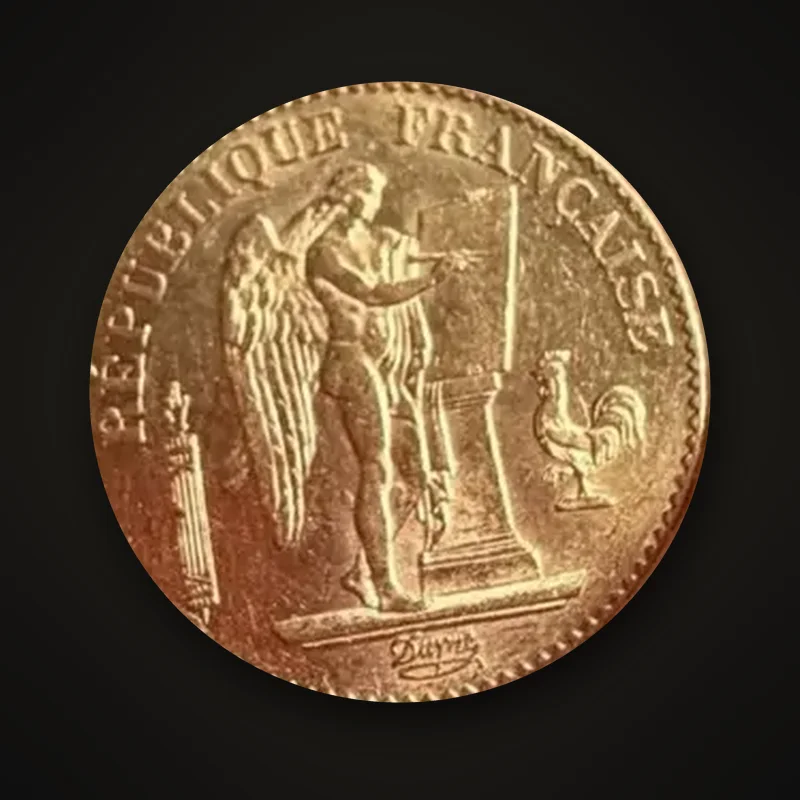
On the obverse, a winged figure engraves an inscription, framed by a fasces and a rooster: this is the Genius of the Republic (Génie), drawn by Augustin Dupré in 1792. The gold 20 francs that bears it was made in Paris under two Republics, in 1848-1849 and then from 1871 to 1898, for a total close to 89 million. A very common coin in family holdings, it becomes rare only for a handful of dates.

Identification

Dupré's gold 20 francs Genius: how to recognise it

Obverse

Allegorical scene facing right: the winged Genius engraves a tablet set on a low altar. A fasces topped by the hand of justice stands on the left, a rooster on the right. Below the scene, the signature “Dupré”; as legend, “RÉPUBLIQUE FRANÇAISE”, meaning French Republic.

Pièce de 20 francs or au Génie, revers

Reverse

A closed wreath surrounds the value “20 FRANCS” and the year; the letter A, mark of Paris, can be read under the date. Motto as legend: “LIBERTÉ ÉGALITÉ FRATERNITÉ”.

Edge
“DIEU * PROTEGE * LA * FRANCE” (may God protect France) in raised letters, on all regular coins of both periods. The burnished flans of 1878, 30 in number, are the exception with a plain edge.
Engraver
Design created in 1792 by Augustin Dupré, then chief engraver at the Mint, reused unchanged in 1848 and in 1871.
Dates and mintages

Dupré's gold 20 francs Genius: key dates

The mint letter never changes: the date is what makes the difference. Over four fifths of the output come from eight years, 1875 to 1878 and 1895 to 1898. The small years are grouped between 1886 and 1894, led by 1888, then 1892 and 1894.

Dupré's gold 20 francs Genius: dates and mintages
YearMintMintageNote
1848A1,543,091Second Republic; burnished flan pieces
1849A1,302,970Ends the Second Republic striking
1871A2,508,494First Third Republic date
1874A1,284,554After two years without striking
1875A11,677,031Heavily struck
1876A8,824,658Heavily struck
1877A12,759,057Highest mintage
1878A9,188,60030 extra burnished flans, plain edge
1879A1,037,522Two anchors: plain, barred
1886A984,875Back after six empty years
1887A1,231,487Small mintage
1888A27,707Key date of the series
1889Aabout 850,000 to 875,000Mintage disputed; 100 extra burnished flans
1890A1,030,140Just over a million
1891A871,101Small mintage
1892A225,706Second key date
1893Aabout 2.5 millionMintage disputed, fairly common
1894A490,838Small mintage
1895A5,293,347Heavily struck
1896A5,330,407Fasces or torch on the reverse
1897A11,068,977Heavily struck
1898A8,866,327Last year of the Genius

Mintage sources: BDOR for 1848-1849; Numista, which follows Le Franc (F.533/1 to F.533/23), for 1871-1898, with CoinVarieties as a check for 1874, 1875 and 1879. Two dates remain uncertain: 1889, given as 853,468, 873,000 or 873,090 coins, and 1893, as 2,457,168, 2,517,168 or 2,547,168. The Third Republic total can therefore only be rounded, to about 86 million. Nothing was struck between 1880 and 1885.

Spotting a low-mintage date

1888 tops the list with 27,707 coins, a figure out of all proportion to the other years. Next come 1892 (225,706) and 1894 (490,838), then three years that stayed under a million: 1886, 1889 and 1891. These small mintages all date from 1886-1894, when the Paris Mint produced few Genius coins.

Two dates also have privy mark variants, the reverse symbols pointing to the director of production and to the chief engraver. In 1879, the anchor appears plain or barred; in 1896, the mark is a fasces or a torch, two varieties that Le Franc gives a number each. Finally, burnished flans were struck separately for presentation: in 1848, in 1878 (30 coins) and in 1889 (100 coins).

Fake Genius coins and altered dates

Because collectors seek them, the small dates attract tampering. On an 1888 or an 1892, look closely at the last digit: a stroke or alignment unlike the others, a field polished or scratched around it, tool marks should stop the eye. The coin produced this way is real gold, but of an ordinary year.

The Genius has also been copied in full, at times in gold of the legal fineness. Signs that betray such copies: wing feathers lacking finesse, a heavy rooster, uneven edge letters, a weight slightly off. Conversely, a coin of 6.45 g and 21 mm with a well-struck edge clears the first filter. A mint letter other than A is in itself a reason for doubt, since Paris struck everything. The full method is on the page how to spot a fake coin (French page).

What wear removes first

The most prominent reliefs on the obverse are the Genius's head, shoulder and chest: that is where the metal goes first. The wing feathers then merge, before the rooster and the fasces. A Very Fine coin (TTB in French grading) still shows distinct feathers and a clean profile; at Fine (TB), wings and rooster have lost their inner detail.

On the reverse, the veins of the closed wreath leaves act as a witness. Do not rely on the legends: set close to the rim, they stay legible well below Fine. Small contact marks in the fields, common even on lightly worn coins, also weigh on the grade. Lastly, cleaning destroys the mint lustre for good: see why not to clean a coin and the grading guide (both in French).

The Genius in the line of 20 francs coins

In 1848, the Second Republic picked for its gold 20 francs the design Dupré had conceived in 1792. The coin was struck only in 1848 and 1849: from 1849, Louis Merley's Ceres type went into production in turn, before the Second Empire brought in the effigy of the Napoleon III 20 francs.

Revived by the Third Republic in 1871, the Genius was produced until 1898 and circulated until 1914, under the shared rules of the Latin Monetary Union that also applied to the Latin Union 20 francs struck by neighbouring countries. In 1899, Chaplain replaced it with the Rooster, but the Genius stayed on the gold 50 francs until 1904 and on the gold 100 francs until 1914. Its common nickname, “the angel”, refers to an allegory, not a religious figure. The period is covered among the coins of the Third Republic (page in French).
In Mougins

Dupré's gold 20 francs Genius in Côte d'Azur

Nothing links the striking of the Genius to Mougins: the whole series came out of the Paris mint. The village, for its part, long lived off the land; French Wikipedia describes it as a commune “historically rural, specialised in jasmine picking”, the flower of the perfumers of the Grasse area. In those families, as in the rest of the canton, late 19th-century gold coinage, Genius coins included, turns up today when estates are settled, sometimes next to Napoleon III 20 francs. A numismatist at the Mougins shop can read their date and grade.

Dupré's gold 20 francs Genius: frequently asked questions

What is the difference between an 1848 Genius and an 1898 Genius?

None in the design: only the date and the regime change. 1848 and 1849 belong to the Second Republic, the dates from 1871 to 1898 to the Third.

Are there Genius coins dated 1880 to 1885?

No: the Paris Mint suspended production for those six years, as in 1872 and 1873. A coin bearing one of those dates should be treated as suspect.

Is the 1894 rare?

With 490,838 coins, it is among the small mintages, behind 1888 (27,707) and 1892 (225,706). It is still far more common than those two dates.

What is a burnished flan?

A coin struck on a polished blank, for presentation rather than circulation. For the Genius, they are known in 1848, in 1878 (30 coins) and in 1889 (100 coins).