Raised or sunken: telling the two designs apart
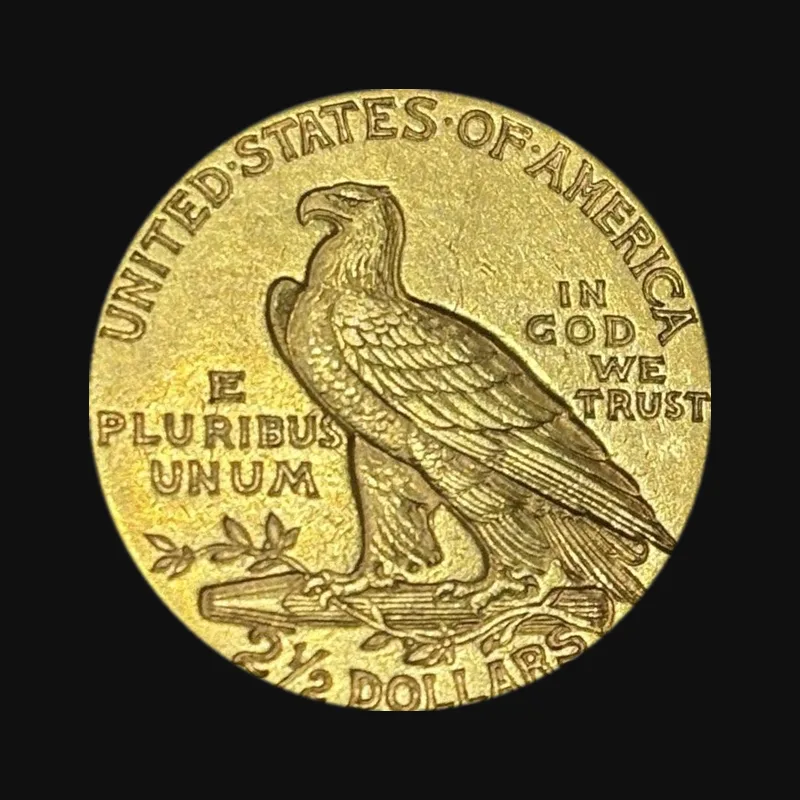
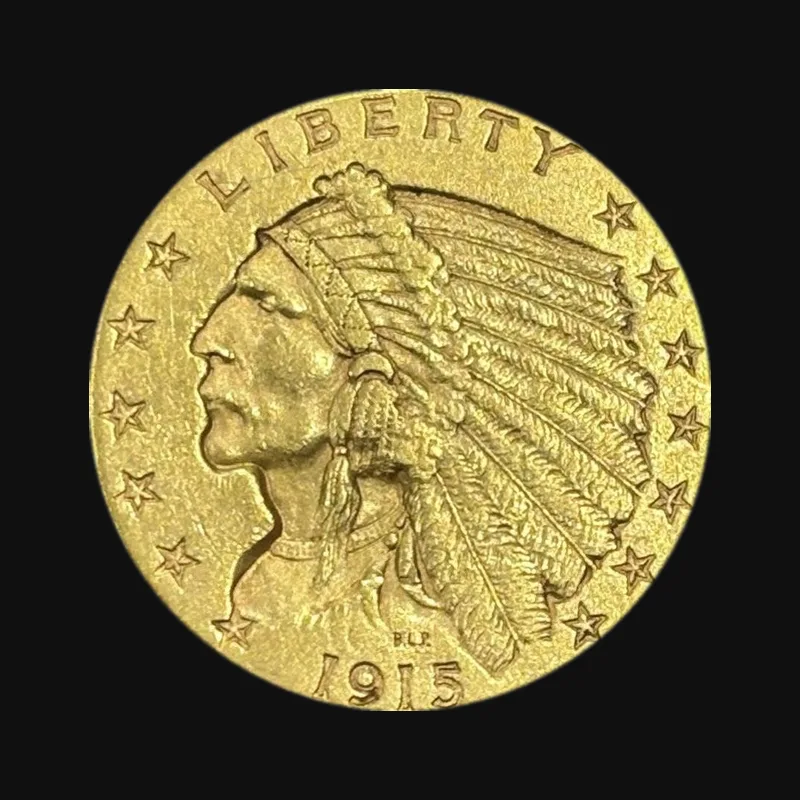
Light the coin from the side, almost level with its surface: on the Coronet the coronet and curls cast a shadow: the portrait stands proud of the field. On the Indian Head it is the reverse, the design forms a hollow and the smooth field is the highest part. The other side settles it: heraldic eagle and “2 1/2 D.” on one, perched eagle and the value in full on the other.
The motto is another clue. The large gold coins with a coronet received it after the Civil War, the quarter eagle did not. A $2.50 Liberty showing “IN GOD WE TRUST” deserves suspicion; the Indian Head always carries it.
The Coronet's mint marks
Gobrecht's design was struck at five mints. Philadelphia covers the whole period. Charlotte, North Carolina, and Dahlonega, Georgia, processed gold from the Southern mines; they stopped in 1860 and 1859 respectively, and Collectors Key notes that their coins are often weakly struck in the centre. New Orleans produced them off and on until 1857, San Francisco from 1854 to 1879. Carson City never struck the denomination.
Two dates stand out. The 1854-S, with a mintage of 246, is thought to survive in only eleven to fourteen pieces. The 1848 CAL. carries “CAL.” on the reverse: some 230 ounces of California gold, shipped to Washington by Colonel R. B. Mason, California's military governor, were used to strike 1,389 coins.
Indian Head: fifteen varieties, one true rarity
The Indian Head has just fifteen combinations, twelve from Philadelphia and three from Denver (1911, 1914, 1925). The key coin is the 1911-D, at 55,680 pieces. Its D is often soft, sometimes nearly invisible: PCGS and NGC list this “weak D” separately. Collectors Key cites a fine wire rim on the obverse of genuine 1911-D coins as a sign of authenticity.
The series ranks among the most counterfeited American gold coins. Forgers have added a D to Philadelphia 1911s, or altered the date of a 1914-D; in the case NGC studied, the added letter was too heavy and ringed by tool marks. More surprising, again according to NGC, the 1911 with no mint mark is copied more often than the 1911-D.
Checks you can make yourself: a weight close to 4.18 g, an 18 mm diameter, no pull from a magnet, and a possible date (no Indian Head between 1916 and 1924). A coin that passes these tests can still be fake: see the guide how to spot a fake coin.
Wear, size and related coins
Because the Indian Head design is sheltered below the field, the flat surfaces suffer first; Collectors Key stresses how readily they keep bag marks. On the Coronet, wear first attacks the raised parts of the portrait. To judge condition, look at the field as much as the design, and never clean the coin: the guide grades of preservation sets out the scale.
Pratt used the same Indian for the $5, and Gobrecht the same Liberty for the $5, $10 and $20. Size settles it:
- quarter eagle: 18 mm, 4.18 g;
- half eagle: 21.6 mm, 8.359 g;
- eagle: about 27 mm, 16.718 g.
See also the pages on the $5 gold coin and the $10 gold coin, or the full range of foreign coins.