Skip to content
United States

The half eagle, the United States $5 gold piece

United States · 1839-1929 · Gold

Written by the Maison Or & Bijoux Mougins team · updated

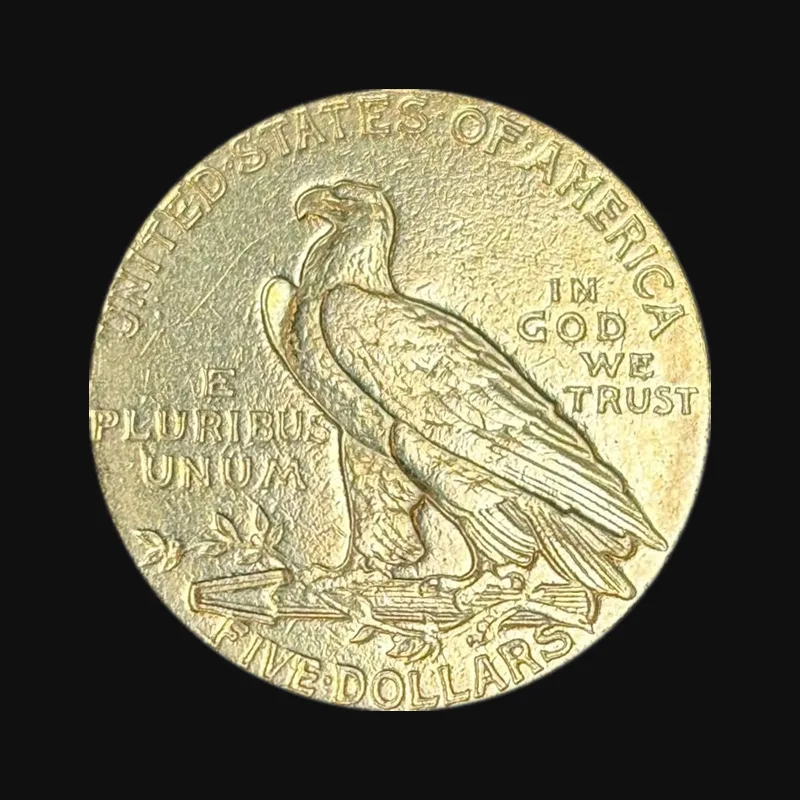
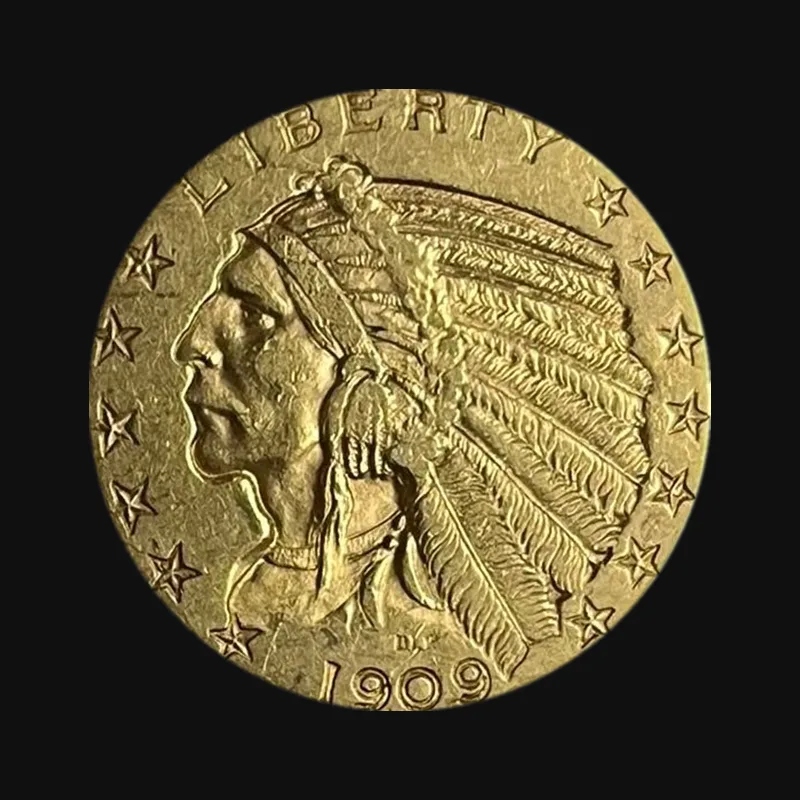
$5 Indian Head gold dated 1909, obverse with the feathered headdress$5 Indian Head gold, reverse with the standing eagle in incuse relief
Photos: Maison Or & Bijoux.
Specifications
CountryUnited States
MetalGold alloy at 900‰, completed with copper
Weight8.359 g
Fine gold7.523 g
Diameter21.6 mm, except in 1839 (22.5 mm)
Denomination5 dollars, officially a “half eagle”
Striking periodCoronet from 1839 to 1908; Indian Head from 1908 to 1916, then in 1929
Mints and marksNo mark: Philadelphia. C: Charlotte. D: Dahlonega (1839-1861), later Denver (from 1906). O: New Orleans. S: San Francisco. CC: Carson City
EngraversCoronet by Christian Gobrecht; Indian Head by Bela Lyon Pratt
EdgeReeded on both designs

The first gold coin of the United States, struck from 1795, the $5 piece is called the half eagle because it is worth half an eagle. Between 1839 and 1929 two designs followed one another on the same 21.6 mm, 8.359 g blank, at 900 fineness. Christian Gobrecht drew the first, a Liberty with a coronet. Bela Lyon Pratt signed the second, a Native American profile whose unusual relief is hollowed into the metal instead of rising from it. As both share a reeded edge, a coin is placed by its design, its year and its mint letter.

Identification

The half eagle, the United States $5 gold piece: how to recognise it

$5 Indian Head gold dated 1909, obverse with the feathered headdress

Obverse

Coronet (1839-1908): Liberty's face turned left, hair gathered at the back of the head, a coronet bearing “LIBERTY”; a ring of thirteen stars surrounds the portrait, above the date. Only the Charlotte and Dahlonega pieces dated 1839 put their mint mark on this side. On Pratt's Indian Head (1908-1929): a feather-crowned Native American profile, facing left, “LIBERTY” above the forehead, stars arranged along both edges and the date at the bottom; the whole design is incuse.

$5 Indian Head gold, reverse with the standing eagle in incuse relief

Reverse

Coronet: eagle with outspread wings carrying arrows and an olive branch, encircled by “UNITED STATES OF AMERICA”, with “FIVE D.” at the base. An “IN GOD WE TRUST” scroll appears above its head in 1866. From 1840 the mint mark is read below the eagle, above the value. Indian Head: an eagle at rest on a bundle of arrows and an olive branch; “E PLURIBUS UNUM” takes the left, “IN GOD WE TRUST” the right, “FIVE DOLLARS” the bottom. The mint mark, to the left of the arrowheads, stands in relief, unlike everything else.

Edge
Reeded, whichever the design.
Engraver
Christian Gobrecht for the Coronet. Bela Lyon Pratt, a sculptor working in Boston and once taught by Augustus Saint-Gaudens, for the Indian Head, at the initiative of William Sturgis Bigelow and with the agreement of Theodore Roosevelt.
Dates and mintages

The half eagle, the United States $5 gold piece: key dates

The date and the mint mark are enough to place a half eagle; with no mark, the coin comes from Philadelphia. The letter D has two meanings depending on the period: Dahlonega (Georgia) from 1839 to 1861, Denver (Colorado) from 1906. The rows below are a selection of landmarks.

The half eagle, the United States $5 gold piece: dates and mintages
DateDesignMintMintageNote
1839CoronetDahlonegaunknownThe only Dahlonega half eagle with its D above the date.
1840CoronetAllunknownThe mint mark moves to the reverse; the module shrinks to 21.6 mm.
1854CoronetSan Francisco268Struck on 19 April 1854; four pieces remain.
1861CoronetCharlotte and DahlonegaunknownBoth Southern mints seized; the end of C and of the Georgia D.
1866CoronetPhiladelphia and San FranciscounknownIN GOD WE TRUST added to the reverse.
1875CoronetPhiladelphia200The smallest business-strike mintage of the Coronet.
1892CoronetNew OrleansunknownO-mint half eagles return, until 1894.
1906CoronetDenverunknownD now points to Colorado.
1908Coronet and Indian HeadPhiladelphiaunknownChangeover year between the two designs.
1909Indian HeadNew Orleans34,200The scarcest Indian Head mintage; the mint closes afterwards.
1916Indian HeadSan FranciscounknownStriking breaks off after this year.
1929Indian HeadPhiladelphia662,000A one-off revival, almost entirely remelted after 1933.

Mintages and mint dates: Collectors Key and CoinWeek; Wikipedia gives 668,000 coins for 1929. Not exhaustive.

Coronet or Indian Head: reading both sides

Run your thumb over the obverse. A portrait you can feel, wearing a coronet, means Gobrecht's Coronet. A profile you barely sense, set below the surface and crowned with feathers, means Pratt's Indian Head: on that design the flat field is the highest point.

The reverse confirms it: an open-winged eagle and the abbreviated value “FIVE D.” on the Coronet, a motionless eagle on a bundle of arrows and the value in full on the Indian Head. No motto: a Coronet from before 1866.

Fake half eagles: where to look

NGC counts Pratt's quarter and half eagles among the trickiest series to authenticate. One imitation reverse die keeps turning up on S-mint fakes dated 1909, 1913, 1915 or 1916; the S on them is stretched, its serifs poorly formed. The sunken date can be reworked too: NGC describes a 1913 turned into a 1919, a date that does not exist for this type.

What you can check yourself:

  • the weight, close to 8.36 g, on scales reading to a hundredth;
  • the diameter, 21.6 mm;
  • a magnet, which must not attract the coin;
  • whether the dates add up: no Indian Head between 1917 and 1928, no Coronet marked C or Georgia D after 1861, no CC after 1893.

A coin of the right weight can still be fake. The complete procedure is in the guide how to spot a fake coin.

Quarter eagle, half eagle, eagle: the right size

Pratt reused his Indian for the quarter eagle; Gobrecht's Liberty also served on the eagle. To avoid mistaking the value:

  • $2.50 (quarter eagle): 18 mm and 4.18 g;
  • $5 (half eagle): 21.6 mm and 8.359 g;
  • $10 (eagle): about 27 mm and 16.718 g.

The $10 has its own page, the American $10 gold coin. Other coins from abroad are grouped under foreign coins.

Judging the condition of an incuse coin

The Coronet wears like most coins, through its relief: the coronet and hair, then the feathers of the eagle's wings. The Indian Head behaves differently, since its design is sheltered below field level: rubbing marks the smooth surfaces first, and a worn piece may keep crisp feathers. So judge condition on the field as much as on the portrait.

Avoid any cleaning, which leaves fine scratches that show clearly under a loupe. For the grading scale, see grades of preservation.
In Mougins

The half eagle, the United States $5 gold piece in Côte d'Azur

The Indian Head's sunken relief comes from Egypt: William Sturgis Bigelow had observed it on Egyptian sculpture at the Boston Museum of Fine Arts before putting it to Theodore Roosevelt. Visitors could see the technique in Mougins itself. From 2011 until it closed in 2023, the Mougins Museum of Classical Art, built up by the collector Christian Levett, showed an Egyptian gallery in its crypt and a large collection of ancient coins; since 2024 the building has housed a museum devoted to women artists. For coins of antiquity, see the page on Greek coins.

The half eagle, the United States $5 gold piece: frequently asked questions

Why is it called a half eagle?

The eagle is the $10 gold coin; the $5 piece is half of it. The half eagle is also the oldest gold coin of the United States, struck from 1795.

My half eagle has no letter: where is it from?

It was struck in Philadelphia: the parent mint left its coins unmarked. The other mints signed C, D, O, S or CC.

A D on an 1855 half eagle: is that Denver?

No: Denver only joined the series in 1906. Before 1862 the D stands for Dahlonega, Georgia.

Why is the 1909 Indian Head marked O sought after?

It is the only Indian Head from New Orleans and the lowest mintage of the design: 34,200 pieces, just before the mint closed.

Was the incuse relief well received?

Not by everyone. In 1908 the numismatist Samuel Chapman complained that the recesses would hold dirt and that the coins would stack poorly and be easy to counterfeit.