Crowned head or walking woman: the instant sort
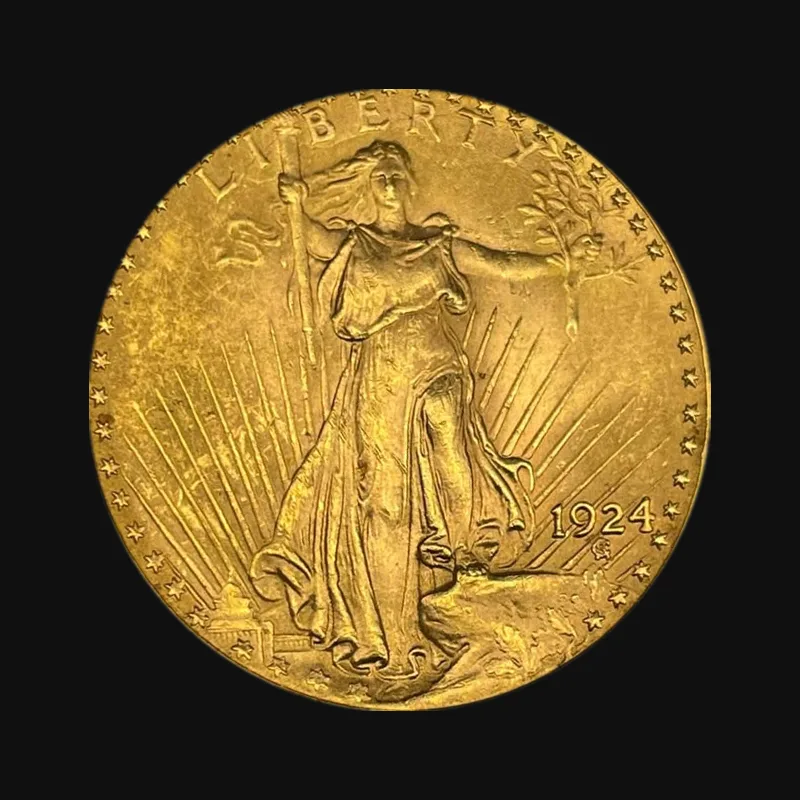
Lay the coin face up. A profile framed by stars, under a diadem: that is a Liberty, struck between 1850 and 1907. A whole figure walking towards you, torch raised: that is a Saint-Gaudens, from 1907 to 1933.
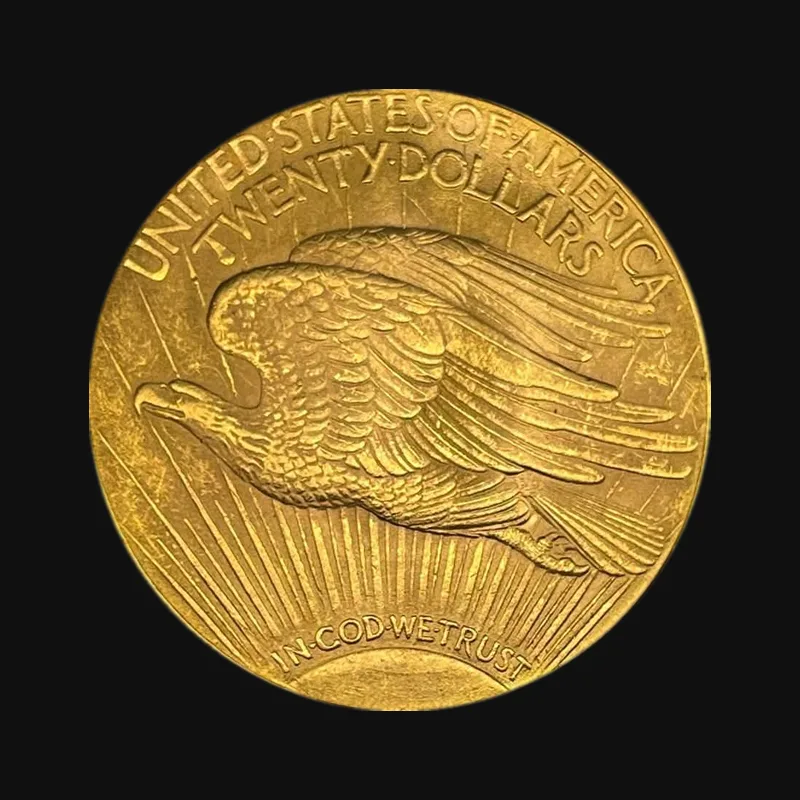
Then turn it over. The Liberty's heraldic eagle bears a shield; the Saint-Gaudens eagle glides above a sun. Finally, roll the edge under your finger: reeding for the first, raised letters for the second.
Variants of a single design
Three sub-types share the Liberty. Until 1866, there is neither motto nor value in full: the reverse makes do with “TWENTY D.”. The years 1866-1876 bring in “IN GOD WE TRUST” above the eagle. From 1877 to 1907, the value is written “TWENTY DOLLARS”. On the side, San Francisco struck a few coins in 1861 with a reverse reworked by Anthony Paquet, dropped at once.
The Saint-Gaudens also changed three times. In 1907, the first coins had a relief so deep that each needed several strikes; they are recognised by their date in Roman numerals, MCMVII. The relief was then lowered and the date switched to Arabic numerals. In 1908, Congress restored “IN GOD WE TRUST”, which Theodore Roosevelt had wanted removed. In 1912, two extra stars greeted New Mexico and Arizona.
Copies, counterfeits and modern coins
Few gold coins have been imitated so much. In the 1960s and 1970s, clandestine workshops produced double eagles for buyers in the Middle East, often in real gold and sometimes at the exact weight: weighing gives false comfort. What gives these copies away is the detail. The relief looks puffed and without crisp edges, the engraver's initials and the numerals are mushy, the field shows small bubbles or craters, the shine looks somehow too new and the gold leans towards an unusual tone. On sought-after dates, a mint letter added or removed is another classic trick.
Do not confuse it either with recent issues from the US Mint. The 2009 ultra high relief Saint-Gaudens, dated MMIX, is in pure gold. The American Gold Eagle, launched in 1986, reuses the 1907 Liberty but shows a nest of eagles on the reverse and carries 50 dollars for an ounce. As for gilt souvenir reproductions, marked “COPY” or not, they weigh much less than 33.44 g. The basic checks are gathered in the guide spotting a fake coin (in French).
The $10, a little brother not to mix up
The $10 eagle went through the same changes, with a Liberty then, from 1907, a head wearing a feathered headdress. It is half as heavy and measures only about 27 mm; its reverse announces “TEN D.” or “TEN DOLLARS”. Its key points are set out on the $10 gold page.
Judging the grade without mistakes
On a Liberty, the first signs of wear show in the locks above the eye and the ear, then on the diadem, whose word “LIBERTY” fades from the top of the letters. On the reverse, the eagle's head, neck and upper wing edge flatten until the plumage disappears.
On a Saint-Gaudens, the bust and left knee of Liberty wear before anything else, followed by the face and the hand holding the torch. The little Capitol loses its columns early. On the reverse, the eagle's wing and body give the measure of wear.
One peculiarity of these coins: many saw little circulation but travelled in bags of 250, which left them with knocks in the field and nicks on the edge. A collector looks at these contact marks as much as at wear. Above all, no cleaning: the grading scale appears in the guide coin grades (in French).
From California gold to a sculptor's design
The discovery of gold in California led Congress, in 1849, to vote for a coin worth two eagles. Longacre signed the design, and regular striking began in 1850. Other mints soon joined in: New Orleans, San Francisco, then Carson City, opened near the Nevada mines. From the 1880s, millions of coins went to Europe, in bags, to pay for trade.
In the early 20th century, Theodore Roosevelt wanted coins worthy of ancient sculpture and turned to Augustus Saint-Gaudens. Born in Dublin to a shoemaker father from a village in the French Pyrenees, the sculptor had studied in Paris, at the École des Beaux-Arts, from 1867. He died in August 1907 without seeing the coin finished, and Charles Barber reduced its relief.
In 1933, Franklin Roosevelt blocked gold exports, then ordered private holders to surrender their coins to the Treasury. The 1933 date never left the vaults, and most of the recent coins were melted. Those sleeping in European banks escaped and came back onto the market after the war. They appear alongside others in the foreign coins section (in French).