Skip to content
France

The 50 francs gold of Napoleon III and the Third Republic

France · 1855-1904 · Gold

Written by the Maison Or & Bijoux Mougins team · updated

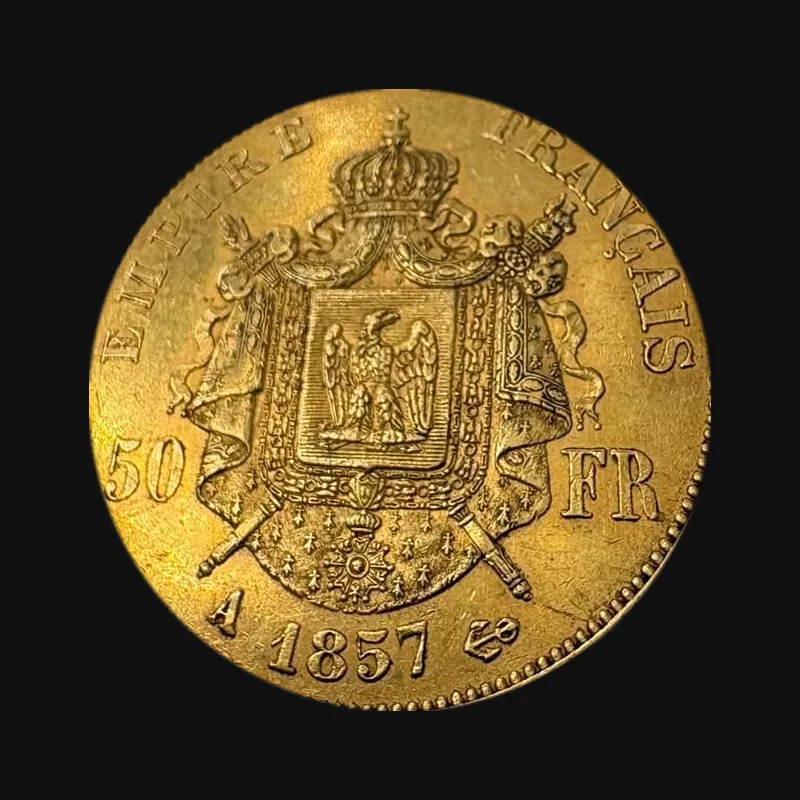
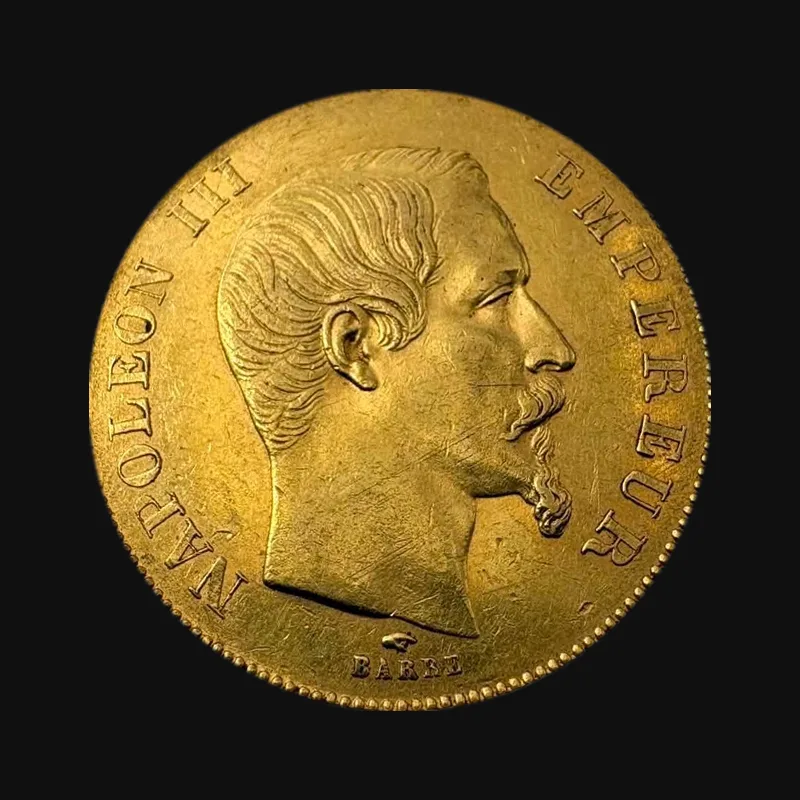
50 francs gold Napoleon III bare head, obverse50 francs gold dated 1857, Paris mint (A), reverse with the imperial arms
Photos: Maison Or & Bijoux.
Specifications
CountryFrance
MetalGold, 900‰ standard
Weight16.13 g
Fine gold14.516 g
Diameter28 mm
Years struckNapoleon III: 1855-1859 then 1862-1868; Genius: 1878-1904
MintsA and BB (Empire), A only (Genius)
EngraverBarre family; Genius model by Dupré
EdgeInscription DIEU PROTEGE LA FRANCE
Total mintageAbout 958,000 coins: 764,385 bare head, 166,989 laureate head, 26,975 Genius
ReferencesLe Franc F.547 to F.549; Gadoury 1111 / KM 785 (bare head) and Gadoury 1113 (Genius) according to CoinVarieties

The middle gold coin of the French system, the 50 francs was struck in fewer than a million pieces over half a century. It weighs 16.13 g, measures 28 mm and holds 14.516 g of pure gold. The Empire supplied most of them between 1855 and 1868, under two successive portraits; the Republic added only a handful of Genius coins between 1878 and 1904.

Identification

The 50 francs gold of Napoleon III and the Third Republic: how to recognise it

50 francs gold Napoleon III bare head, obverse

Obverse

Two imperial portraits facing right, signed BARRE under the neck and surrounded by “NAPOLEON III EMPEREUR”: uncovered head until 1859, head adorned with laurel from 1862. The Third Republic replaced the emperor with a winged Genius tracing letters on a tablet, a fasces on one side and a rooster on the other, beneath “RÉPUBLIQUE FRANÇAISE”.

50 francs gold dated 1857, Paris mint (A), reverse with the imperial arms

Reverse

On the imperial side, a mantle carries the eagle shield set on the thunderbolt and encircled by the collar of the Legion of Honour; around it, “EMPIRE FRANÇAIS”; “50” and “FR” frame the shield, with date and mint at the base. On the Republican side, a wreath encloses the value and the year.

Edge
Raised letters spelling “DIEU PROTEGE LA FRANCE”. A few 1855 coins, and the patterns and burnished flans dated 1862, 1868 and 1878, have a plain edge.
Engraver
The Barre family: Désiré-Albert for the laureate head and, according to BDOR and Abacor, for the bare head too, which CoinVarieties assigns instead to Jacques-Jean. For the Genius, Désiré-Albert Barre engraved the model conceived by Augustin Dupré in 1792.
Dates and mintages

The 50 francs gold of Napoleon III and the Third Republic: key dates

Every year and mint recorded by Le Franc appears here. Three remarks help you find your way: the Empire accounts for almost all the volume, with a peak in 1857 in Paris; the letter BB beats Paris in 1859 and in 1867; the smallest numbers are found in 1868, at both mints, and among the Genius coins, apart from 1904.

The 50 francs gold of Napoleon III and the Third Republic: dates and mintages
YearMintMintageRemarks
1855A151,754Plain-edge variety
1855BB6,854First BB
1856A96,564
1857A319,501Record year
1858A85,140
1858BB9,135Low
1859A34,025End of the bare portrait
1859BBabout 61,400Higher than A; see the note
1862A24,418First laureate portrait
1862BB7,310
1863BB8,251BB mint alone
1864A28,682Paris alone
1865A3,740Uncertain figure
1866A39,155Highest laureate mintage
1866BB17,307
1867A11,671
1867BB20,437Exceeds Paris
1868A4,223Under 5,000
1868BB1,795Lowest of the denomination; last BB
1878A5,294First Genius, burnished flans included
1887A301Very scarce
1889A100Genius, Exhibition year
1896A800
1900A200Very scarce Genius
1904A20,250Genius, common date

Numbers taken from BDOR and Abacor, which differ only for 1859 A (34,025 on one side, 34,063 on the other); the list of combinations is Le Franc's (F.547/1 to 8, F.548/1 to 11, F.549/1 to 6). The 1859 BB mintage depends on the author: 61,374 (BDOR, Abacor), 61,354 (CGB, after Le Franc), 61,534 (CoinVarieties), 32,000 (Krause, as reported by Greysheet). The 30 burnished flans of 1878 are part of the 26,975 Genius coins; CoinVarieties, which leaves them out, reaches 26,945. It also gives 6,850 coins for 1855 BB.

Three questions to identify your coin

Who is on the obverse? The emperor or a winged Genius. If it is Napoleon III, look at his hair: with no laurel, the coin belongs to 1855-1859; with laurel, to 1862-1868. The Genius covers 1878-1904.

Which letter is on the reverse? On imperial coins, A stands for Paris and BB for the other mint that struck this denomination; it is read near the date. On the Genius you should only find A.

Is the date possible? No 50 francs gold was struck in 1860, in 1861 or between 1869 and 1877. For 1856 and 1857 only A exists; for 1863 only BB. The Genius has six dates in all: 1878, 1887, 1889, 1896, 1900, 1904. Any other combination deserves a second look, or a numismatist's opinion.

Other coins with the same designs

Napoleon III and the Genius appear on several gold values, and confusion comes quickly on a photograph. The 20 francs napoléon, at 21 mm and 6.45 g, is much smaller (Napoleon III 20 francs); the 100 francs gold, at 35 mm and 32.26 g, much bigger, with “100 FRS” on the reverse. The Genius 20 francs, extremely widespread, reproduces the Republican scene in miniature.

Before 1855, the largest current gold coin was the 40 francs, 26 mm across, last struck under Louis-Philippe. Much later, the Hercules 50 francs of 1974-1980 took up the value in silver, on 41 mm: nothing to do with 19th-century gold.

A short history of a discreet denomination

BDOR and Abacor trace the creation of the 50 francs gold to a decree of 12 December 1854. The two mints chosen, Paris and BB, struck from 1855. The change of design in 1862, when the laurel appeared, affected all imperial gold coins. After 1868, no further 50 francs was struck under the Empire.

With 931,374 coins for the two Napoleon III types, the denomination remained marginal next to the 20 francs of the same period. The Republic revived it now and then with Augustin Dupré's Genius, notably for the Universal Exhibitions of 1878 and 1889, up to a final issue in 1904. To place the coin in its period, see the page on 19th-century coins (in French).

Patterns, alterations and copies

Off-series pieces are rare and well catalogued: plain-edge 1855 coins and patterns on burnished flans struck in Paris; laureate patterns of 1862 and 1868 with a plain edge; for the Genius, 30 burnished flans in 1878, 100 coins in 1889 and two 1878 patterns, one with “grande écriture” (large lettering). Abacor also notes that the 1866 A count may include coins dated 1865, which makes the mintage of the latter year uncertain.

Forgers aim first at the 1887 and 1900 Genius coins. Two methods: making a complete copy, in gold or gilt metal, or turning a genuine 1904 into an 1900 by altering the last digit. Against the first, the scale and the calliper (16.13 g, 28 mm), a close look at the edge letters and the sharpness of the portrait or wings; against the second, a loupe around the final zero. More methods in the guide to unmasking a fake coin (in French).

Where wear shows

On the bare-headed emperor, the lock above the ear and the cheekbone flatten first; on the laureate emperor, it is the leaves, whose veins disappear. On the reverse, watch the eagle, the thunderbolt and the collar.

On the Genius, the most exposed relief is the upper body, followed by the wings and the rooster; on the reverse, the wreath wears first in the detail of its leaves.

Heavy and compact, the 50 francs often keeps traces of its time in coin bags: edge knocks, hits in the field. They weigh on the assessment of condition. Leave the coin as it is, without rubbing it, and see the grading guide and the risks of cleaning (both in French).
In Mougins

The 50 francs gold of Napoleon III and the Third Republic in Côte d'Azur

No known striking or episode ties the 50 francs gold directly to Mougins, long a farming village which, according to Wikipedia, specialised in picking jasmine. As anywhere in France, these coins can nonetheless surface in estates and collections in the area. To find out which of the three designs you hold, and which mint struck it, the Mougins shop offers a free coin valuation with a numismatist.

The 50 francs gold of Napoleon III and the Third Republic: frequently asked questions

How many types of 50 francs gold are there?

Three: Napoleon III bare head (1855-1859), Napoleon III laureate head (1862-1868) and the Genius of the Third Republic (1878-1904). Le Franc lists them as F.547, F.548 and F.549.

Which 50 francs gold had the smallest mintage?

Under the Empire, the 1868 BB, with 1,795 coins. The Genius goes lower still: 100 coins in 1889, 200 in 1900, 301 in 1887.

Why does my 50 francs have knocks on the edge?

These heavy coins often circulated or were stored in bags, against other coins. The resulting knocks count in the grade, without making the coin suspect.

Is there a 50 francs gold dated 1870?

No. Imperial striking stopped in 1868 and the Genius only began in 1878. A date between 1869 and 1877 matches no recorded striking.