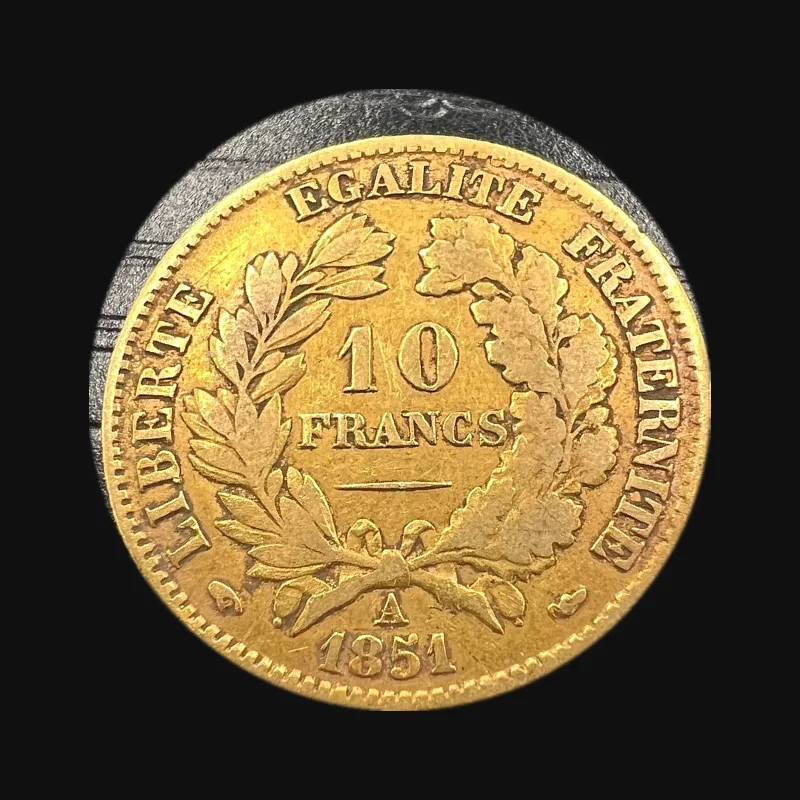
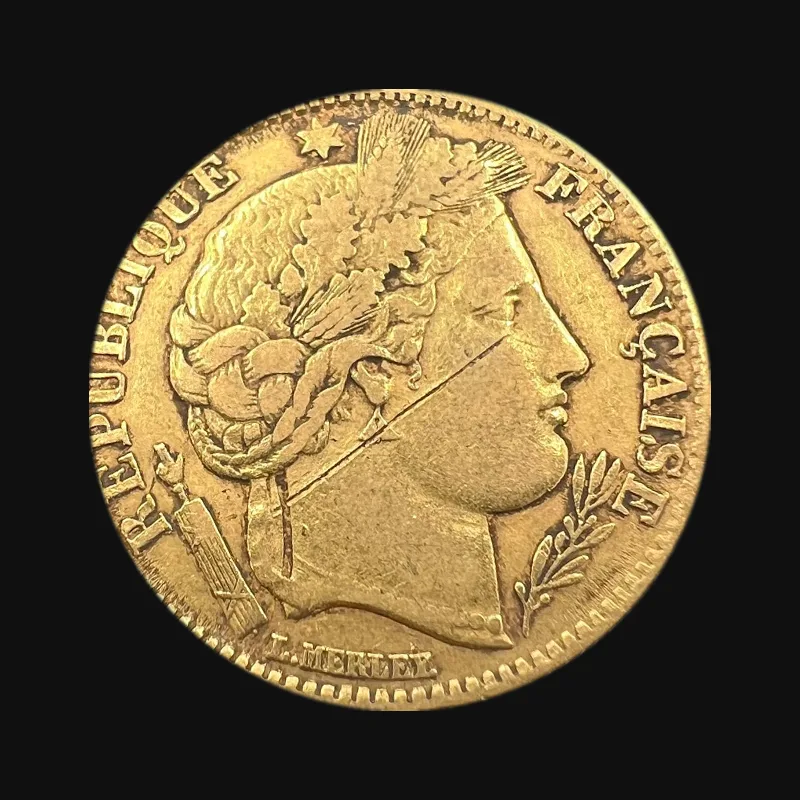
The 1850 Ceres, a coin born of Californian gold
In 1850, France was already striking gold 20 and 40 francs, two denominations created in 1803. The Second Republic added a lighter 10 francs, just as gold mined in California was arriving in abundance on the European market: a small gold coin became handy for everyday payments. The design chosen was Louis Merley's, a head of Ceres crowned with wheat ears, the one seen on the examples photographed for this page.
This first striking lasted only two years. From 1854, the portrait of Napoleon III took its place; Ceres came back only in 1878, under the Third Republic, in small quantities, before giving way to Chaplain's Rooster in 1899. The same design appears, on a larger scale, on the gold 20 francs Ceres.
From the Second Empire to the Rooster: the other types
Napoleon III bare head, from 1854 to 1860, came in two formats. The first, about 17 mm, was struck only in 1854 and 1855; the second, 19 mm, appeared in 1855 with the same weight, which made it thinner. The Second Empire produced considerable quantities: more than 60 million for the large module alone.
Napoleon III laureate head, from 1862 to 1868, is recognised by the laurel wreath; some thirty million coins left the A and BB mints. In 1862, a transitional reverse known as hybrid carries a reduced “10”.
The Rooster, from 1899 to 1914, pairs Chaplain's Marianne with a standing rooster, without a mint letter, as on the 20 francs Rooster. There is no point looking for a gold 10 francs with the Genius: that type exists only as 20, 50 and 100 francs.
Low mintages and exceptional pieces
The hardest date is 1855 BB, bare head large module, of which Strasbourg produced only about 32,000. Next come the 1895 Ceres (213,999 coins), the 1909 Rooster (598,795), the 1850 Ceres and 1858 BB. The Ceres of 1878 and 1889, on burnished flans, at 30 and 100 examples, are presentation pieces for the Paris World Fairs, not pocket money.
For the varieties, get the loupe out. The 1850 comes with one or other of two Ceres hairstyles. The 1854 small module changes edge and size of the letter A. Paris, in 1860, varied the drawing of the figure 6 and the privy mark. From 1863 to 1866, the BB on laureate heads is sometimes small, sometimes large. Lastly, the Rooster received a matt flan in 1899 and 1900.
Spotting an imitation
The gold 10 francs has been copied, like every circulating gold coin. At 3.22 g for 19 mm, a difference in material shows first on a scale accurate to the hundredth: beyond a few hundredths of difference, be wary. A calliper then checks the diameter and thickness. Under a loupe, compare the sharpness of the hair and the regularity of the reeding with those of a known-genuine coin. These checks are set out step by step in the guide to spotting a fake coin (in French).
Another source of confusion: small gilt tokens and medals, often mounted as pendants, that mimic the look of the Rooster or the emperor. Without a face value or a date, they are not gold 10 francs.
Reading condition on the high points
On the Ceres, wear first attacks the wheat ears of the wreath and the locks on the forehead; a coin whose grains of wheat can no longer be told apart is at best Fine (TB). On Napoleon III, look at the hair near the ear and the goatee, and on the laureate head the detail of the leaves. On the Rooster, check Marianne's hair over the forehead, the rim of the cap, then the feathers of the breast and wing.
Such a small coin moves quickly from one grade to the next, and knocks in the fields count for a lot. Holed, soldered or taken out of a jewel, it no longer interests collectors much. Avoid any cleaning: read why not to clean a coin, and the grading guide for the full scale (both in French).