Obverse
The monarch's effigy, its direction varying from reign to reign, and a Latin legend in shortened form. For George V it reads “GEORGIVS V D G BRITT OMN REX F D IND IMP”; Victoria, early in her reign, shows only “VICTORIA DEI GRATIA”.
Written by the Maison Or & Bijoux Mougins team · updated
| Country | United Kingdom |
|---|---|
| Alloy | 22-carat gold, i.e. 916.7‰ |
| Mass | Sovereign 7.988 g; half 3.994 g |
| Pure gold content | Sovereign 7.322 g; half 3.66 g |
| Size | Sovereign 22.05 mm; half 19.30 mm |
| Value | One pound; ten shillings (50 pence after 1971) for the half |
| Striking | Since 1817, with several pauses |
| Mint letters | None in London; S, M, P (Australia), C (Canada), I (India), SA (South Africa) |
From George III to Charles III, every British monarch has had a gold sovereign. The one-pound coin launched in 1817 and its ten-shilling half have crossed two centuries in the same 22-carat alloy, which makes them easier to identify but also makes copies formidable. The reign, the reverse and any mint letter are enough to place most pieces.
The monarch's effigy, its direction varying from reign to reign, and a Latin legend in shortened form. For George V it reads “GEORGIVS V D G BRITT OMN REX F D IND IMP”; Victoria, early in her reign, shows only “VICTORIA DEI GRATIA”.
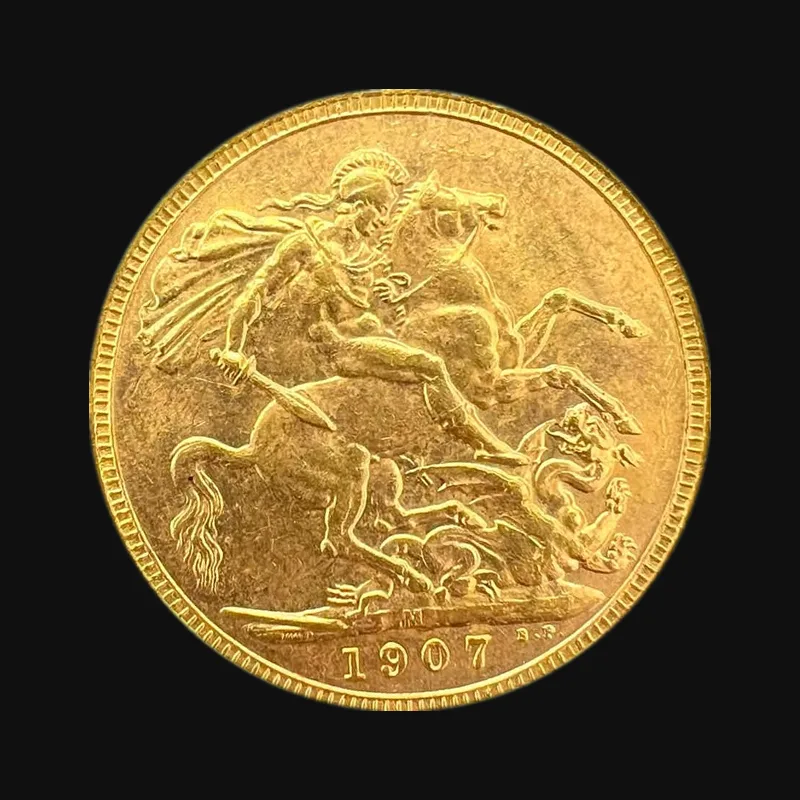
On the sovereign two designs follow each other: Pistrucci's Saint George (initials “B.P.” beside the date) between 1817 and 1825, then from 1871 onwards, and between those dates the royal arms on a crowned shield circled by laurel, kept in London until 1874. The half sovereign carries the shield until 1893; it then switches to Saint George, but without Pistrucci's signature.
Sovereigns and half sovereigns do not share the same difficult years, so the table tells them apart. Look for the mint letter on the strip of ground under the galloping horse, above the date, if the reverse shows Saint George, and below the laurel if the shield is shown. Without one, the piece comes from London.
| Date | Coin | Mint | Mintage | Note |
|---|---|---|---|---|
| 1817 | Half sovereign | London | unknown | First half, shield reverse. |
| 1819 | Sovereign | London | 3,574 | One of the great rarities of the series. |
| 1821 | Half sovereign | London | unknown | Shield withdrawn: it was mistaken for a gilt sixpence. |
| 1838-1874 | Sovereign | London | unknown | Young Victoria and shield; none struck in 1840 or 1867. |
| 1879 | Sovereign | London | unknown | Low output, seldom in fine condition. |
| 1887 | Sovereign | London | unknown | Boehm's Jubilee portrait appears. |
| 1893 | Half sovereign | London | unknown | First Saint George half, Victoria's old head. |
| 1916 | Sovereign | Ottawa | about 6,000 | Key to the Canadian series. |
| 1918 | Half sovereign | Perth | unknown | Dated 1918 but probably struck in 1919 or 1920; very few known. |
| 1919 | Sovereign | Melbourne | 514,257 | Sought after. |
| 1922 | Sovereign | Melbourne | 608,306 | Rare. |
| 1923 | Half sovereign | Pretoria | unknown | Proof only. |
| 1924 | Sovereign | Sydney | 394,000 | Difficult. |
| 1926 | Half sovereign | Pretoria | unknown | End of circulating half sovereigns. |
| 1931 | Sovereign | Melbourne | 57,809 | Melbourne closes its series. |
| 1974 | Sovereign | London | unknown | Striking relaunched, Arnold Machin effigy. |
| 1980 | Half sovereign | London | unknown | The half returns, in proof quality. |
Mintages: Wikipedia (1819) and the per-mint tables of goldsovereigns.co.uk; half sovereign dates from Wikipedia. Because Australian sovereigns were melted in bulk, the official mintage does not measure real rarity. The table keeps landmark dates.
The first sovereign, in 1817, bears the profile of George III; George IV and William IV follow, before Victoria's long reign. The queen changes face three times: Wyon's young head, hair gathered with a ribbon (1838-1887); Boehm's Jubilee head, a small crown set on the veil (1887-1893); Brock's veiled old head (1893-1901).
The two reigns met most often are those of Edward VII, engraved by de Saulles, and George V, by Mackennal: their sovereigns came out by the tens of millions between London and the Empire. After the 1933-1956 gap, Elizabeth II appears in turn under the chisel of Mary Gillick, Arnold Machin, Raphael Maklouf, Ian Rank-Broadley and Jody Clark. Charles III's portrait, by Martin Jennings, closes the gallery for now.
Under Victoria two variants deserve attention: the model specific to the Sydney mint (1855-1870), which adorns the queen's hair with a banksia sprig, and some 1863 sovereigns marked with a small “827” on the obverse, probably an ingot number according to Wikipedia.
Same fineness, same portraits, but a different calendar. The half sovereign stays loyal to the crowned shield until 1893, so a half with the young Victoria never shows Saint George. From that date the horseman appears on the small flan, without the letters “B.P.”.
Its rarities do not overlap with those of the sovereign. The 1821 half was soon replaced: its shield could be confused with a gilded silver sixpence. No half sovereign is dated 1819. The Perth piece dated 1918 was probably struck a year or two later. At Pretoria, 1923 exists only in proof and 1926 marks the end of circulation, while sovereigns carry on until 1932.
The Royal Mint revived it in 1980, in proof quality. Its face value is now 50 pence, a consequence of decimalisation in 1971.
The sovereign's paradox: many of its fakes are 22-carat gold and weigh exactly what they should. After the Second World War the coin still served as trusted money in Greece and the Middle East. Clandestine workshops in Italy, Switzerland, Syria and then Lebanon took advantage. A prosecution of forgers even failed, the court ruling that the coin was no longer current money; the Royal Mint answered in 1957 by striking again.
By eye and under a loupe, the clues are these: soft relief, the sandy surface of a moulded piece, irregular milling, clogged digits and letters. A forger also gives himself away with an impossible combination, such as an Edward VII portrait on a George V date or a mint letter that was never struck in that year. Full method: spotting a fake coin (French guide).
The sovereign was often worn before being put away: mounted as a pendant, set in a ring, soldered to a brooch. These uses leave solder traces, claw marks on the edge, a cut loop. Spot them under a loupe, even before judging the wear.
For that, Saint George sets the measure: helmet, mane and the horse's muscles are the first points to fade, then the dragon's tail and scales. On the obverse, look at the beard and ear under George V, the cheek and hair under Edward VII, the young Victoria's bun. On a half sovereign these details are finer and go sooner.
A cleaning scratch takes more value from a rare date than from a common one: better to rub nothing, as cleaning a coin explains. For the scale of grades, see coin grades (both in French).
The sovereign was never legal tender in France, but the Grasse area knew British people who used it. From the 1880s English families settled for the winter on the heights of Grasse, the town next to Mougins. In the spring of 1891 Queen Victoria stayed there for several weeks at the Grand Hôtel and attended services at the Anglican church of St John the Evangelist, finished a few weeks earlier and nicknamed the “chapelle Victoria” ever since. The sovereigns struck that year happened to carry the queen's Jubilee portrait, engraved by Boehm. Nothing says those coins stayed in the area; some do turn up, in any case, in estates around Grasse, next to Latin Monetary Union 20 francs.
The Edward VII and George V pieces, issued by the million in London and the Empire mints, as well as the Elizabeth II sovereigns produced from 1957.
No. The half sovereign keeps the crowned shield until 1893, the year Victoria's old head appears. A Saint George half is therefore later.
It stands for the Pretoria mint in South Africa, which struck sovereigns from 1923 to 1932 and half sovereigns until 1926.
Hardly. The 22-carat alloy contains a little copper, which gives a slightly rosy tint, but fakes of the right fineness have exactly the same colour.