Fourteen subjects, five families
The commemoratives read like a programme: honouring science, letters and the great dates of the Republic.
- Scientists and writers: Marie Curie (1984), Émile Zola (1985), René Descartes (1991), André Malraux (1997).
- The motto: the Statue of Liberty (1986), La Fayette for Equality (1987), Fraternity (1988).
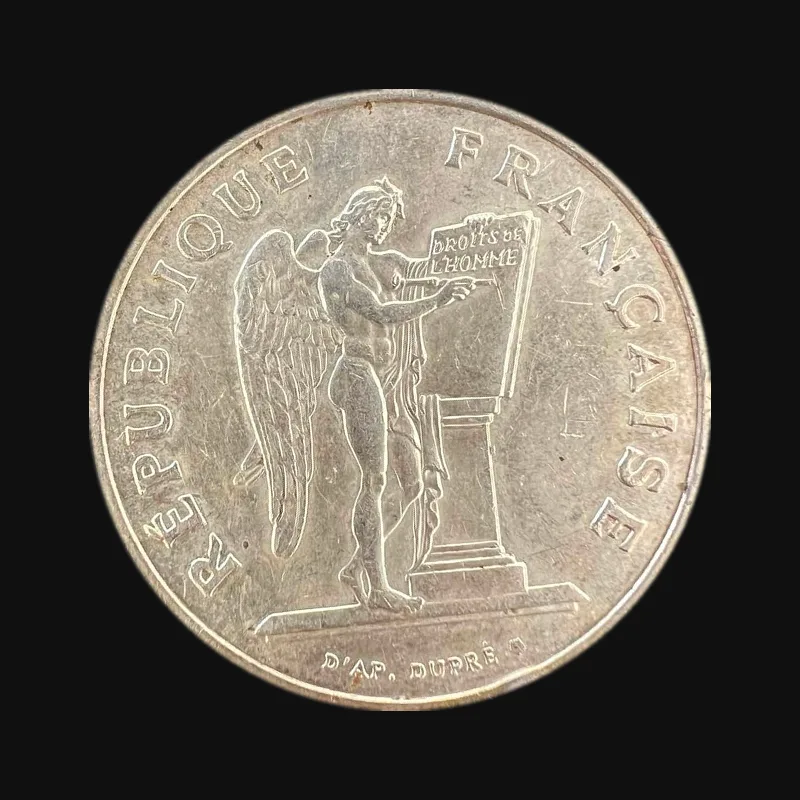
- The Revolution: the Rights of Man (1989) and Liberty Leading the People after Delacroix (1993).
- Origins: Charlemagne (1990) and Clovis (1996).
- Europe and the war: Jean Monnet (1992), the Liberation of Paris (1994), 8 May 1945 (1995).
As each subject bears a single date, recognising it is enough to place the coin in the table.
Dating and sorting a Panthéon
The Panthéon is the coin where the date matters most. The first three years were struck by the million, then output collapses: under a million in 1985, 81,000 in 1987, 5,000 in 1990. After that, circulation pieces are counted in thousands and several years exist only in sets. The Panthéon was also struck in proof from 1991 to 2001.
Second criterion: the Chief Engraver's symbol. Émile Rousseau's dolphin, in office from 1974 to 1994, gives way to Pierre Rodier's bee; it is found on the Panthéon from 1995.
Collector finishes, trials and fakes
Collector finishes. A few subjects were offered in a premium finish, in small runs: the Marie Curie (1,000 in proof), the Zola (5,000 in proof, 50,000 uncirculated) and the La Fayette (25,000 in brilliant uncirculated). The field is dazzling; keep the pouch, case or certificate.
Outside the series. Trials bear the word ESSAI. Cased collector 100 francs, such as the 1993 Louvre in silver or the gold Marie Curie, are other issues. The 100 francs Cochet of the 1950s holds no silver; the 10 and 50 francs Hercule, at the same standard, weigh 25 g and 30 g.
Copies. A coin that is too light, blurred relief, the grainy surface of a cast piece should all raise doubts. More pointers in spotting a fake coin (in French).
Storing without damage
Few of these coins circulated: differences in condition come from storage. The broad smooth background catches the slightest scratch, the edge keeps knocks and the silver stains in old plastics. The first reliefs to flatten are the top of the dome on the Panthéon, the cheekbone and the hair on a portrait.
Store each coin separately, in a neutral capsule or holder, and never rub a stain. See grades of condition and why not to clean a coin (both in French).
A silver coin against the tide
When the Panthéon 100 francs appeared in 1982, French everyday coins were made of base metals. Heavy, precious and of high face value, the newcomer was immediately set aside by the public.
From 1984 the Paris Mint turned it into a yearly commemorative vehicle. Mintages, around 4 to 5 million until 1992, fell below 2 million from 1993 to 1996, then below half a million in 1997, the year of the last commemorative.
The Panthéon went on being struck for collectors until 2001. With the euro, these coins lost their legal value in 2002; the Banque de France took them back until February 2005. Other coins of the period are presented in new francs and silver coins (in French).