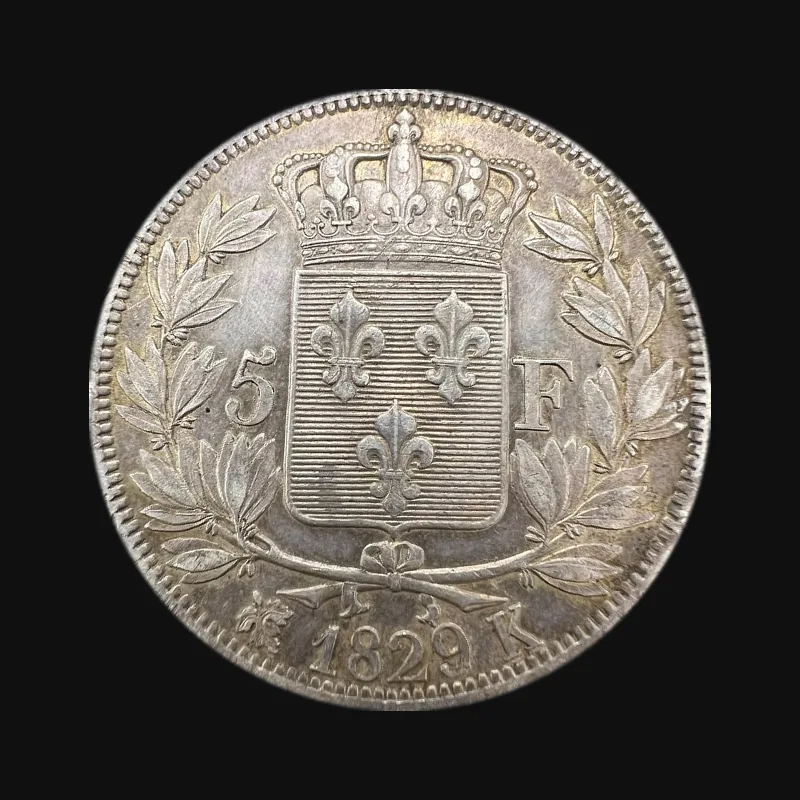
Livres or francs: telling the two écus apart
A large white coin with the arms of France is not necessarily royal in the pre-Revolution sense. Three clues decide.
- The value: the kings' écu was worth 6 livres and does not say so; the decimal écu shows “5 FRANCS” or “5 F”.
- The language: Latin legends on nearly all royal écus, French ones on the 5 francs, including those of Louis XVIII and Charles X.
- The weight: about 29.5 g for a Louis XVI écu, 25 g for a 5 francs.
The kings' coins are covered on the French pages for royal silver écus and Louis XVI écus; the revolutionary transition in coins of the Revolution.
Eight regimes, one standard
When it created the franc on 15 August 1795 (28 Thermidor Year III), the Convention ordered a silver 5 francs coin from Augustin Dupré. The law of 7 Germinal Year XI, in 1803, set the franc at 5 g of silver, 900‰ fine: 25 g for the 5 francs, a figure that stayed the same to the end.
Every regime left its mark. The Empire brought Napoleon's profile, the Restoration its arms and a Latin edge, the July Monarchy three successive portraits of the king. The Second Republic revived Hercules and introduced Ceres; Napoleon III added his bust, first bare-headed and then laureate; the Third Republic returned to Hercules.
From 1865, the Latin Union joined France with three neighbours, Belgium, Switzerland and Italy, around écus of identical specification. Falling silver prices against gold ended production: there is no French date after 1878. The coins nonetheless circulated until the First World War. Full background on French coinage from 1795 to 1870.
Privy marks, re-cut numerals and fakes
Privy marks frame the date: one symbol for the mint director, another for the engraver. When they change, two issues of the same year can be separated. The classic case is Paris in 1871: a bee on ordinary coins, a trident on those struck under the Commune, when Zéphirin Camélinat was in charge of the mint.
Under the Directory, short of new dies, the year was altered on an old one: the “Year 6 over 5” or “Year 8 over 5” écus come from this and are catalogued separately.
Fakes range from coins cast in tin to cheat a 19th-century shopkeeper to recent reproductions. Weigh (25 g), measure (37 mm), check that the edge letters are crisp and evenly spaced, and listen to the ring. A grainy surface and mushy legends point to casting. See how to spot a fake coin.
Judging an écu's condition
These coins served for a long time: they are usually worn, and unworn examples from before 1848 are rare.
- Hercules: torso, knee, the hand resting on Liberty's shoulder, the drapery.
- Portraits: the locks above the ear, the cheek, the laurel wreath; the back of the head on Louis-Philippe.
- Reverse: the veins of the wreath or the sharpness of the arms.
The coin's weight invites knocks on the edge and in the field. A polished coin takes on a white, flat look that collectors mark down. Further reading: how a coin's grade is assessed and why not to clean.