Skip to content
France

The silver écus of Louis XVI (1774-1793)

France · 1774-1793 · Silver

Written by the Maison Or & Bijoux Mougins team · updated

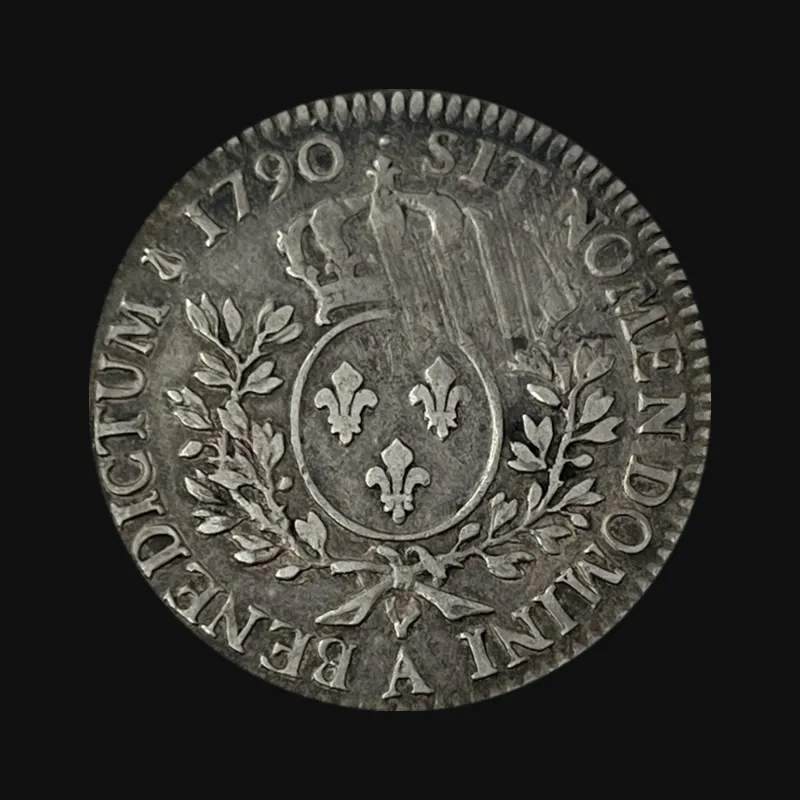
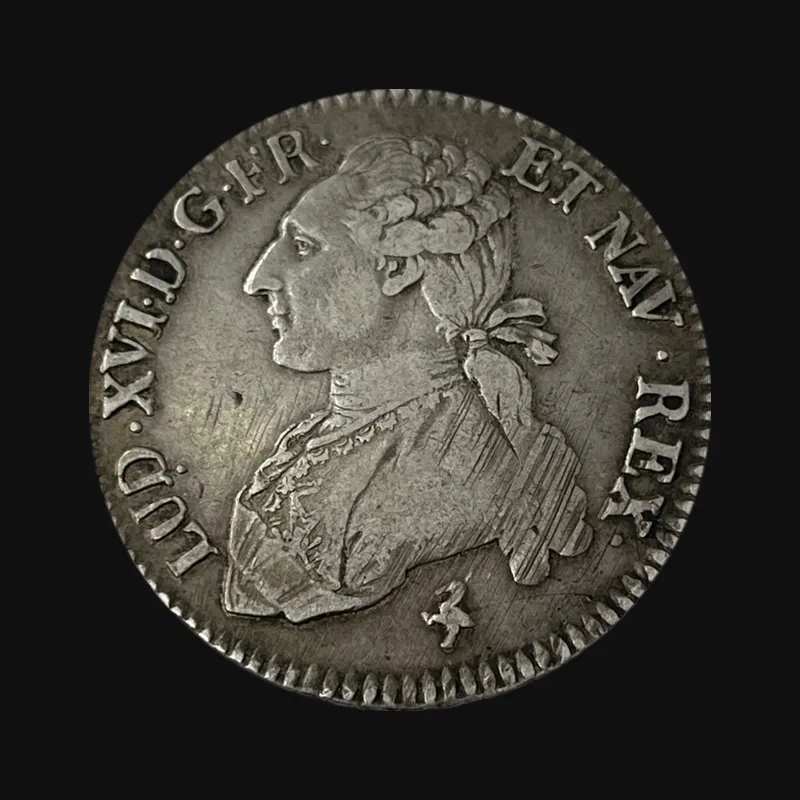
Half écu of Louis XVI, 1790, obverse with draped bustHalf écu 1790, Paris mint (A), reverse with the shield of France
Photos: Maison Or & Bijoux.
Specifications
CountryFrance
MetalSilver, 917‰ fine (11 deniers)
Statutory weight29.488 g for the écu, about 14.7 g for the half écu, in both types
Fine silverAbout 27 g for the écu (29.488 g × 0.917)
DiameterÉcu: 39 to 40 mm; half écu: about 30.5 to 33 mm, depending on the sources and the coins measured
Denomination6 livres (écu), 3 livres (half écu)
Years struck1774-1792 for the Latin type; 1792-1793 for the constitutional type, after patterns dated 1791
MintsA (Paris), AA (Metz), B (Rouen), BB, D (Lyon), H (La Rochelle), I (Limoges), K (Bordeaux), L (Bayonne), M (Toulouse), MA (Marseille), N (Montpellier), Q (Perpignan), R (Orléans), T (Nantes), W (Lille), Pau (a cow); & (Aix) for some fractions
EngraverDuvivier (obverse), Dupré (constitutional reverse)
EdgeLettered: royal Latin motto, then “LA NATION LA LOI ET LE ROI”
ReferencesGadoury 356 (olive-branch écu), 356a (Béarn), 55 (constitutional “FRANÇOIS”, according to Coinvarieties); KM 564, 572, 615; Davenport 1333 to 1335; Duplessy 1708 and 1718

Under Louis XVI, the large silver coin changed its face twice in less than twenty years. First came the king in an embroidered coat, with the arms of France between two branches on the reverse; then, in 1792, a bare head with “ROI DES FRANÇOIS” and a winged genius engraving the word “CONSTITUTION”. The language of the legend, Latin or French, and the reverse design are enough to tell which of the two écus you are holding.

Identification

The silver écus of Louis XVI (1774-1793): how to recognise it

Half écu of Louis XVI, 1790, obverse with draped bust

Obverse

Écu of 1774 to 1792: bust of the king facing left in an embroidered coat, with the sash of the Order of the Holy Spirit and hair tied with a ribbon, signed “B. DUVIV. F” below the bust; legend “LUD. XVI. D. G. FR. ET NAV. REX.”. Constitutional écu of 1792-1793: bare head facing left, hair tied back, legend “LOUIS XVI ROI DES FRANÇOIS” (“FRANÇAIS” on a few issues) and the date in figures below the head.

Half écu 1790, Paris mint (A), reverse with the shield of France

Reverse

Écu of 1774 to 1792: crowned oval shield of France between two tied branches, legend “SIT NOMEN DOMINI BENEDICTUM” with the date, mint mark at the bottom. Constitutional écu: winged genius standing right, engraving “CONSTITUTION” on a tablet resting on an altar signed “DUPRE”, fasces topped by a Phrygian cap on the left, cockerel on the right; legend “REGNE DE LA LOI”, mint mark, and in the exergue “L'AN 4 DE LA LIBERTÉ” (1792) or “L'AN 5” (1793).

Edge
“DOMINE SALVUM FAC REGEM” on the écu with the Latin legend; “LA NATION LA LOI ET LE ROI” on the constitutional écu, according to the records of the Musée Carnavalet, Ghent University Library and CGB listings.
Engraver
Pierre-Benjamin Duvivier for the coated bust and for the king's head on the constitutional écu; Augustin Dupré, appointed chief engraver of the mints on 11 July 1791, for the genius on the reverse.
Dates and mintages

The silver écus of Louis XVI (1774-1793): key dates

Some twenty mints and two types: the table keeps the year and mint combinations that serve as landmarks, the most frequent as well as the rarest. For the constitutional écu, almost no mintages by mint are known; the catalogues agree on one point only: Paris 1792 and Paris 1793 are the dates met most often, and provincial mints are rare.

The silver écus of Louis XVI (1774-1793): dates and mintages
TypeYear and mintMintageRemarks
Olive-branch écu1775 A309,200Paris, second year of the reign
Olive-branch écu1776 L1,039,462Bayonne, a very productive mint for this type
Olive-branch écu1789 An/kMost common date of the type according to Coinvarieties
Olive-branch écu1790 MA243,443Marseille, the Provençal mint
Béarn écu1791, Pau (cow)1,690Lowest mintage of the series; titles specific to Béarn
Olive-branch half écu1790 A, 1791 An/kThe two most frequent dates of the half écu
Olive-branch half écu1792 An/kLast date of the type
Pattern for the constitutional écu1791n/k“L'AN 2 DE LA LIBERTÉ”; a museum piece
Constitutional écu1792 A, year 4n/kOne of the two most available dates
Constitutional écu1792 BB, year 4n/k“FRANÇAIS” legend in the second half-year, very rare
Constitutional écu1792 MA, year 4n/kMarseille; rare, especially the second half-year
Constitutional écu1793 A, year 5180,505The other available date
Constitutional écu1793 BB, year 5n/k“FRANÇAIS” legend
Constitutional écu1793 N, year 5n/kMontpellier; rare, like most provincial mints
Constitutional half écu1792 A year 4, 1793 A year 5n/kAbout 14.7 g for 33 mm

Mintages and remarks from Coinvarieties, which draws on Droulers, Duplessy, Gadoury and Davenport; the 1791 pattern and the half écus from the Musée Carnavalet records. “n/k”: mintage not known or not found. The republican 6-livre écu of 1793, without a portrait, is not an écu of Louis XVI and is not listed here.

Latin or French: sorting your écus in a minute

Everything turns on the language of the legend. If you read “LUD. XVI. D. G.”, you have the first type, struck from 1774 to 1792. If you read “LOUIS XVI ROI DES FRANÇOIS”, it is the constitutional écu of 1792-1793.

The first type goes by two names. Auction catalogues call it the “olive-branch” or “coated bust” écu; the Musée Carnavalet describes the same branches as laurel and calls it the “laurel” écu. It is one and the same coin: same bust, same reverse, same motto.

The half écu repeats each type on a smaller scale. The scale settles it: about 29.5 g for the écu, about 14.7 g for the half. The fifth, tenth and twentieth écus of the Latin type are much smaller.

Then there is Béarn. The Pau mint, which used a cow instead of a letter, struck the Latin type from 1775 to 1791 with titles adapted to Navarre and Béarn. For the earlier écus, from Louis XIII to Louis XV, see the page on royal silver écus.

The constitutional écu: legends, dates and mints

The reverse is the work of Augustin Dupré, winner of the 1791 competition for the new coinage. The genius of France inscribes the Constitution, between the fasces topped with the cap of liberty and the cockerel. The mint mark sits on the right, next to the cockerel.

Three details make the varieties.

  • The double date. The year in figures is on the obverse, the year of Liberty on the reverse: year 4 for 1792, year 5 for 1793, the era starting in 1789. The 1791 patterns read “L'AN 2”.
  • The spelling. The older form “FRANÇOIS” predominates. Some issues already read “FRANÇAIS”, notably at the BB mint in 1792 and 1793; for the half écu, Coinvarieties reports this form outside Paris.
  • The half-year. Catalogues separate coins struck in the first and second half of the year, which catalogues tell apart by the punctuation of the legend around the date.

In Paris, two small symbols, the privy marks, identify those responsible for production: a leopard below the king's neck and a lyre beside the fasces. The guide to French mints helps with the other mint letters.

Do not confuse: patterns, the republican écu, 5-franc coins, copies

The 1791 patterns. Before regular striking, the mint produced patterns of the constitutional type dated 1791 and “L'AN 2 DE LA LIBERTÉ”. The Musée Carnavalet holds several, some heavier than standard and others struck on one side only. A coin dated 1791 with the genius is therefore not a circulation coin.

The republican écu of 1793. After the fall of the monarchy, a 6-livre écu reused Dupré's genius but without the king's head: its legend names the Republic. It belongs with the coins of the Revolution.

The 5-franc coin. It weighs 25 g, is denominated in francs and dates at the earliest from year IV of the Republic (1795-1796). Dupré's genius gives way to Hercules.

Copies. Like other sought-after écus, the constitutional écu may have been copied. Weigh to a hundredth of a gram: a genuine écu comes to about 29.4 to 29.5 g unless heavily worn. Look at the edge: its incuse letters, sharp and even, are hard to imitate, whereas a cast copy often shows a seam or blurred lettering. A genius with soft outlines, a cockerel without distinct feathers or a dull ring should raise doubts.

Where to look for wear, type by type

Olive-branch écu. On the obverse, follow the curls above the ear, then the embroidery of the coat and the knot of the sash. On a lightly worn coin, each embroidery motif can be read separately; on a heavily worn one, the coat becomes a smooth surface. On the reverse, the leaves of the branches end up merging and the ornaments of the crown become rounded.

Constitutional écu. On the king's side, the temple and the tied locks flatten first. On the genius side, look at the figure's chest and knee, the upper edge of the wings and the tail feathers of the cockerel. The tiny letters of “CONSTITUTION” disappear quickly: if they are still legible, the coin saw little circulation.

Some écus show adjustment marks, file lines made on the blank to bring it to the correct weight before striking. These are manufacturing marks, not damage. An even grey patina is normal; metal that is too bright and covered in fine scratches points to cleaning. Never clean such a coin before showing it to a numismatist.

From the livre to the franc: the écu in years of upheaval

The reign began with an écu unchanged since the 1726 reform. Calonne's recoinage of 1785 affected gold only: the louis lost weight, while the écu kept its 29.488 g.

Assignats appeared in December 1789. By May 1791, 100 livres in paper could be exchanged for only 73 livres in coin. Silver coins left circulation for savings tucked away at home, and yet in 1792 the mints struck the new écu proclaiming the “reign of law”.

The monarchy fell in August 1792; the last coins in the king's name are dated 1793. On 7 April 1795, the law of 18 germinal year III made the franc the monetary unit, and the law of 15 August 1795 set the one-franc coin at 5 g of 900‰ silver. In April 1796, the franc was defined as one livre and three deniers. Louis XVI's écus went on circulating for a long time alongside coins in francs, which is why they turn up so often in family drawers.
In Mougins

The silver écus of Louis XVI (1774-1793) in Côte d'Azur

Under Louis XVI, Mougins was a Provençal village whose lord, until the Revolution, remained the Abbey of Lérins. The Aix mint, marked &, stopped working in 1786, and Provençal écus were then struck in Marseille, marked MA: Coinvarieties records 243,443 olive-branch écus dated 1790 MA, and the constitutional écu of 1792 MA is rare. In the 19th century, Mougins belonged to the arrondissement of Grasse, part of the Var until it joined the Alpes-Maritimes in 1860: the écus kept by families around Grasse circulated within a French setting, on this side of the river.

The silver écus of Louis XVI (1774-1793): frequently asked questions

“Olive-branch” or “laurel” écu: is it the same coin?

Yes. These are two names for the same écu with a Latin legend, struck from 1774 to 1792: catalogues speak of olive, the Musée Carnavalet of laurel.

What does “L'AN 4 DE LA LIBERTÉ” mean?

It is a second date, counted from 1789. Year 4 corresponds to 1792 and year 5 to 1793, a date also shown in figures below the king's head.

Why do some écus read “FRANÇOIS” and others “FRANÇAIS”?

“FRANÇOIS” is the older spelling and the most common. A few issues of 1792 and 1793 already use “FRANÇAIS”; collectors look for them.

My constitutional écu has fine lines across the king: is it damaged?

Not necessarily. They are often adjustment marks, filed on the blank before striking to correct its weight. A numismatist can tell them apart from recent scratches.

More coins
Sources