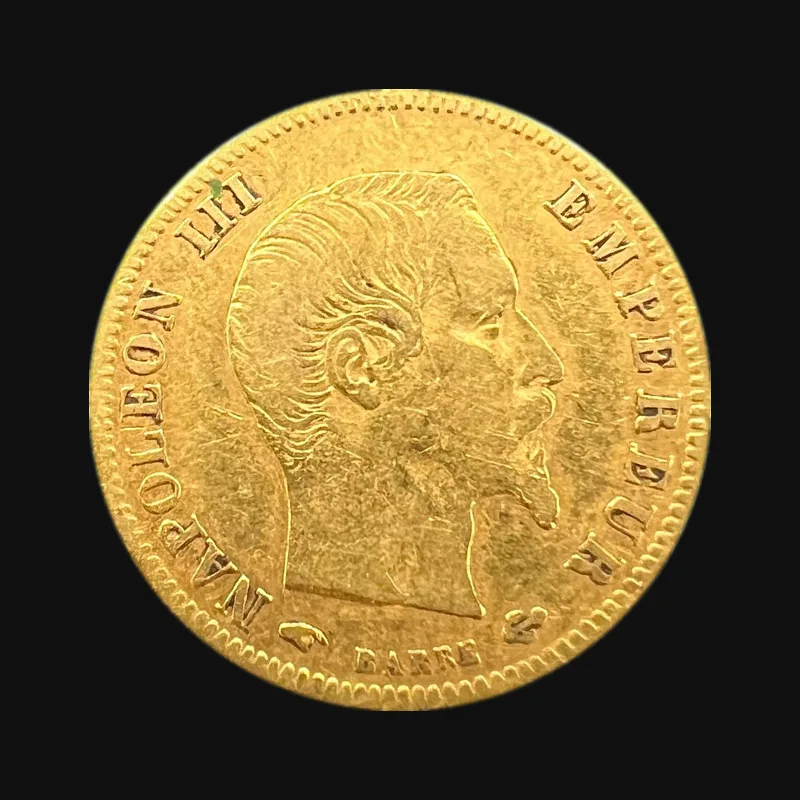
Obverse
Napoleon III in right-facing profile, legend “NAPOLEON III EMPEREUR”. Plain head from 1854 to 1860; head crowned with laurel, a ribbon tied at the back, from 1862 to 1868. Under the truncation of the neck, the signature BARRE.
Written by the Maison Or & Bijoux Mougins team · updated
| Country | France |
|---|---|
| Metal | Gold, 900‰ fineness |
| Weight | 1.6129 g, i.e. 1.61 g rounded |
| Fine gold | 1.4516 g |
| Diameter | Approx. 14.4 mm in 1854-1855 (small module), 16.7 mm from 1855 to 1860, 17 mm from 1862 to 1868 |
| Types | Bare head small module, bare head large module, laureate head |
| Mints | Paris (A); Strasbourg (BB) from 1858; neither Rouen nor Lyon |
| Mintage | About 46.7 million pieces from 1854 to 1868 |
| References | F.500/500A, F.501, F.502; KM 787, KM 803 |
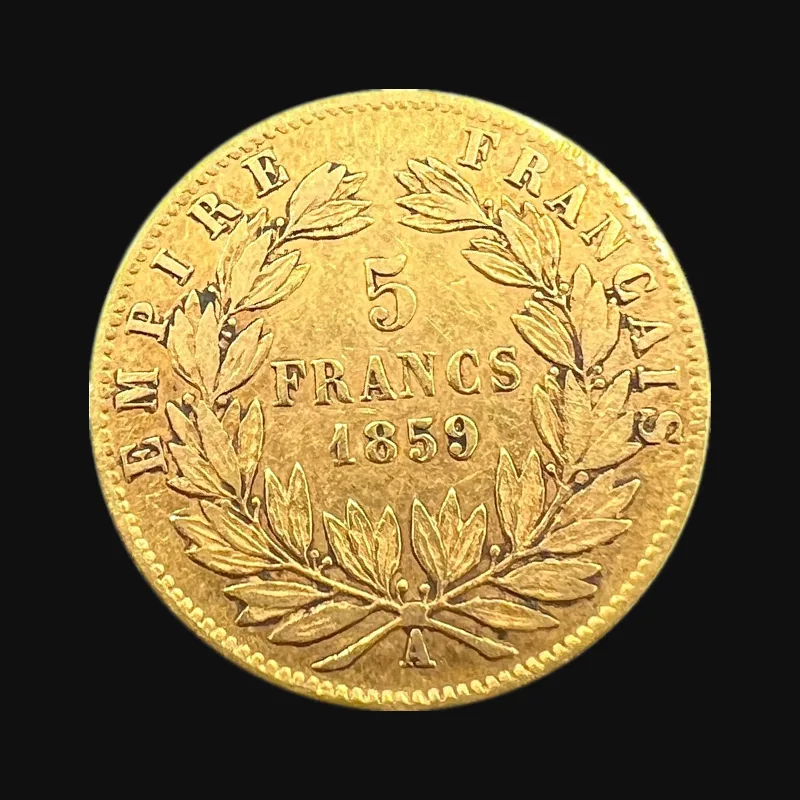
The coin photographed by the Mougins shop is a bare-head gold 5 francs of 1859, marked A under the knot on the reverse: it therefore comes from Paris, although Strasbourg was also striking the type that year. The 1859 date holds the annual record for the series, with 5,659,773 pieces from Paris. Between 1854 and 1868 France produced nearly 47 million of these coins, all at the same weight of 1.61 g of 900‰ gold, in three successive guises.
Napoleon III in right-facing profile, legend “NAPOLEON III EMPEREUR”. Plain head from 1854 to 1860; head crowned with laurel, a ribbon tied at the back, from 1862 to 1868. Under the truncation of the neck, the signature BARRE.
A laurel wreath closed by a knot, holding the value “5 FRANCS” on two lines and the year. Around the edge: “EMPIRE FRANÇAIS”. Mint mark under the knot, between two privy marks: A or BB.
BDOR mintages by year and mint. The year 1859, that of the coin photographed by the shop, brings together 5,659,773 pieces in Paris and 2,247,999 in Strasbourg: the most plentiful date of the gold 5 francs. Two thin dates are seldom met: the 1855 large module, struck in 1,352 pieces, and the 1858 BB, at 31,488. The missing 1861 separates the two portraits.
| Year | Mint | Mintage | Note |
|---|---|---|---|
| 1854 | A | 3,562,208 | 14.4 mm, plain then reeded edge |
| 1855 | A | 937,732 | End of the small module |
| 1855 | A | 1,352 | Large module: first striking |
| 1856 | A | 2,960,085 | 6 over 5 variety known |
| 1857 | A | 3,479,167 | No BB this year |
| 1858 | A | 2,982,985 | |
| 1858 | BB | 31,488 | Strasbourg begins |
| 1859 | A | 5,659,773 | Date of the photographed coin; peak |
| 1859 | BB | 2,247,999 | |
| 1860 | A | 4,798,130 | Bee, 6 over 5 |
| 1860 | BB | 2,021,675 | 6 over 5 variety |
| 1862 | A | 1,100,515 | Laureate head arrives |
| 1862 | BB | 882,075 | |
| 1863 | A | 1,590,708 | |
| 1863 | BB | 1,103,564 | |
| 1864 | A | 2,239,561 | Most produced laureate |
| 1864 | BB | 899,564 | |
| 1865 | A | 824,020 | Paris low for the laureate |
| 1865 | BB | 927,585 | |
| 1866 | A | 1,948,610 | |
| 1866 | BB | 1,388,489 | |
| 1867 | A | 1,006,173 | |
| 1867 | BB | 1,504,435 | |
| 1868 | A | 1,864,491 | Last year |
| 1868 | BB | 726,994 | Lowest laureate run |
Mintages: BDOR. Other published figures: CGB (936,176 for the 1855 A small module) and Heritage (1,177,494 for 1862 A). Le Franc's varieties appear in the notes, without a line of their own.
No other year beats 1859: 5,659,773 pieces left the Paris mint and 2,247,999 the Strasbourg mint, all bare heads on the 16.7 mm flan. It was also the first full year of the BB mint, which had struck only 31,488 pieces in 1858. On an 1859 coin, the letter under the knot on the reverse gives the origin: A for Paris, as on the piece photographed by the shop, BB for Strasbourg.
The date is therefore anything but rare; rather, it marks the peak of large-module output, a year before the bare head came to an end.
Created by decree on 12 January 1854, the first gold 5 francs is only about 14.4 mm across. A second decree, in July 1854, replaced its plain edge with a reeded one. Too tiny, it was soon given up: in July 1855 a ministerial decision sent 888,000 pieces to be melted, and the type was demonetised in 1859.
The 16.7 mm large module replaced it from 1855, at the same weight. After the gap of 1861, the laureate head took over in 1862 at 17 mm, with an unchanged reverse. The 20 francs Napoleon III, by contrast, changed its reverse at that time, which makes comparing the two misleading.
Besides the gold 10 francs, two families of coins cause confusion. Napoleon III's silver fractional coins carry the same profile; the 50 centimes measures 18 mm, weighs 2.5 g and shows “50 C” on white metal. The Ceres-type gold 5 francs of the Third Republic (1878-1889) has no imperial portrait. The silver 5 francs crown, at 37 mm and 25 g, cannot be mistaken for it.
On so small a diameter you need a 10× loupe and slanting light. The high points wear first: hair above the ear and cheekbone on the bare head, laurel leaves on the laureate head. On the reverse, the veins of the leaves, then the knot and privy marks, gradually fade. Do not clean the coin; the slightest scratch would show. The guides on conservation grades and cleaning (in French) give the details.
Gold discoveries in California and then Australia made the metal plentiful in Europe in the early 1850s. France then filled out its range: a Ceres 10 francs in 1850, then, in 1854, the gold 5 francs and the 10 francs with the emperor's effigy. In 1865 the Latin Union convention listed the gold 5 francs among the coins common to France, Belgium, Italy and Switzerland. French striking halted in 1868, and official withdrawal only came in 1928. See also the Latin Union 20 francs.
When the 1859 coin photographed by the shop left the Paris presses, Mougins was not yet part of the Alpes-Maritimes: the commune belonged to the arrondissement of Grasse, in the Var department. After the Treaty of Turin of 24 March 1860, which joined the County of Nice to France, a new Alpes-Maritimes department was formed by adding that arrondissement, taken from the Var, to the County; Wikipédia dates its creation to 14 June 1860. The bare heads were thus struck while Mougins was in the Var, and the laureate heads, from 1862, after it had entered the new department.
It depends on the letter under the knot on the reverse. In 1859 both Paris (A) and Strasbourg (BB) struck the gold 5 francs; the coin photographed by the shop bears an A.
Under a loupe, examine the last figure of the date: the loop of a 5 can be made out beneath the 6. The variety is known for 1856 A, 1860 A and 1860 BB.
Do not try to remove the mount yourself, as you could damage the edge. Show the coin as it is to a numismatist during a free appraisal.
No. Striking stopped in 1868 at both mints; later years appear in no mintage table.