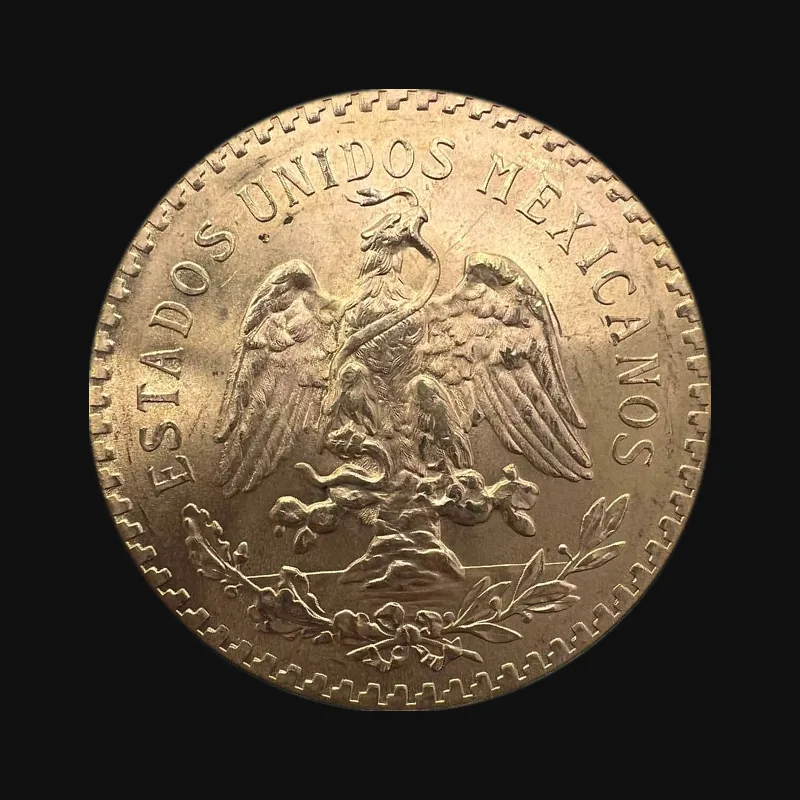
Obverse
Mexico's national emblem: on a cactus, an eagle grips a snake in its beak. An oak sprig and a laurel sprig surround it, below the circular legend “ESTADOS UNIDOS MEXICANOS”.
Written by the Maison Or & Bijoux Mougins team · updated
| Country | Mexico |
|---|---|
| Metal | Gold, 900‰ fine, alloyed with 10% copper |
| Total weight | 41.666 g |
| Pure gold | 37.5 g, or 1.2057 oz |
| Diameter | 37 mm |
| Thickness | about 2.8 mm |
| Striking periods | 1921-1931 and 1943-1947; restrikes dated 1947 afterwards |
| Mint | Mexico City |
| Catalogue numbers | KM# 481 (regular type), KM# 482 (1943) |
At 37 mm and 41.666 g, the Centenario is far bigger than any French gold coin. Mexico launched it in 1921, a hundred years after independence, and gave it 37.5 g of pure gold, a little over 1.2 ounces. The date 1947 dominates the drawers: it was kept on millions of official restrikes. Pieces dated 1921, 1931 or 1943 are the exceptions collectors look for.
Mexico's national emblem: on a cactus, an eagle grips a snake in its beak. An oak sprig and a laurel sprig surround it, below the circular legend “ESTADOS UNIDOS MEXICANOS”.
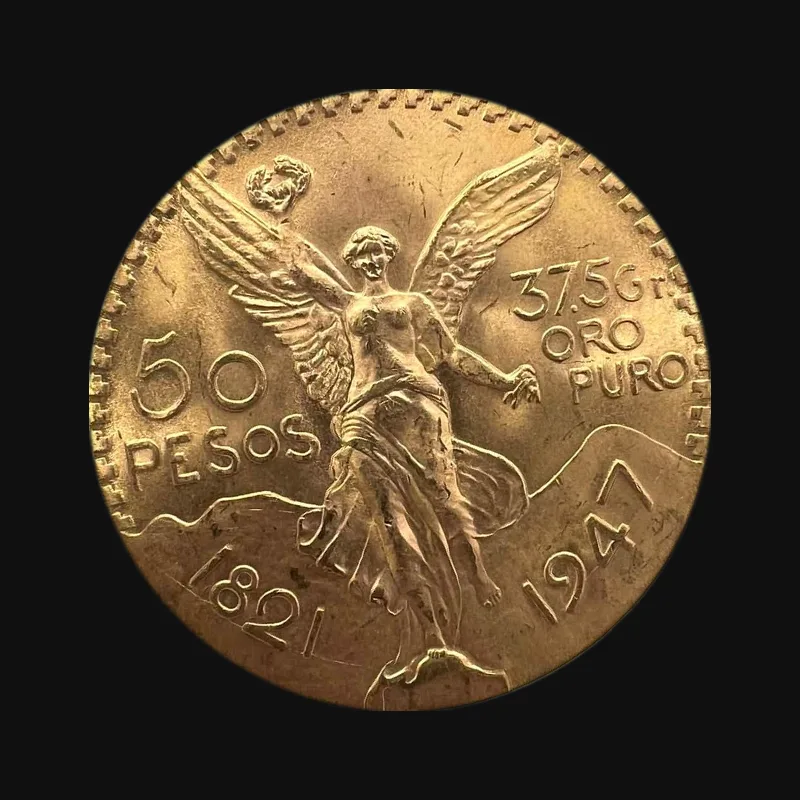
A winged Victory, copied from the one crowning the Independence Column in Mexico City, raises a laurel wreath and holds broken chains. Behind her rise two volcanoes, Popocatépetl and Iztaccíhuatl. The field carries “50 PESOS” and “37.5 Gr. ORO PURO”. Below the statue, the year 1821 appears on the left; the date of striking is on the right.
First find the date on the right of the reverse, then look it up below. The low mintages are 1921 (180,000) and 1931 (137,000). 1943 is the type stripped of the words “50 PESOS”. As for 1947, the date appears mostly on restrikes.
| Year | Type | Mintage | Remarks |
|---|---|---|---|
| 1921 | Centenario | 180,000 | First year, the centenary itself. |
| 1922 | Centenario | 463,000 | |
| 1923 | Centenario | 432,000 | |
| 1924 | Centenario | 439,000 | |
| 1925 | Centenario | 716,000 | Peak of the first series. |
| 1926 | Centenario | 600,000 | |
| 1927 | Centenario | 606,000 | |
| 1928 | Centenario | 538,000 | |
| 1929 | Centenario | 458,000 | |
| 1930 | Centenario | 372,000 | |
| 1931 | Centenario | 137,000 | Last year before the halt, smallest mintage of the series. |
| 1943 | No denomination | 89,000 to 89,400 | Gold weight engraved left and right of the Victory, no “50 PESOS”. |
| 1944 | Centenario | 593,000 | “50 PESOS” returns to the reverse. |
| 1945 | Centenario | 1,012,000 | |
| 1946 | Centenario | 1,588,000 | |
| 1947 | Centenario | 309,000 | Genuine strikes of the year, mixed with the restrikes. |
| 1949-1972 | Restrike dated 1947 | 3,975,654 | Source of most pieces seen today. |
| 1996 | Restrike dated 1947 | unknown | Around 8 million according to Wikipedia and CoinWeek; 302,000 more between 2000 and 2009. No official figure checked. |
Mintages from 1921 to 1947 come from the English and Spanish Wikipedia articles, which rely on the Bank of Mexico; the 1949-1972 restrike figure comes from NGC. For 1943, Greysheet and dealers' notes do not all give the same total.
Many owners read 1821 first and think they hold an early nineteenth-century coin. That number, engraved on the left below the Victory, commemorates the end of the war of independence and appears on every piece. The actual year of manufacture is the one on the right.
The statue itself is a historical landmark: it is the Victory of the Independence Column, a monument unveiled in Mexico City in 1910 that locals call “El Ángel”. Mexico was emerging from a decade of revolution, and the 1921 coin was meant to mark the centenary of 1821.
Striking stopped in 1931, in the depths of the world crisis, then resumed in 1943 because gold coins were in demand. After 1947 the Bank of Mexico kept producing 50 pesos to bring its gold to market, but without changing the date on the dies. From 1949 to 1972, 3,975,654 pieces were struck this way, and further campaigns followed, notably in 1996.
These restrikes are genuine: same fineness, same weight, same design. No mark sets them apart. They can often be recognised by a dazzling, almost reflective field and a lack of wear, though that is not enough to decide. The 309,000 coins struck during the year 1947 therefore remain almost impossible to isolate.
For a single date the denomination leaves the reverse. The gold weight, “37.5 Gr. ORO PURO”, is then split on either side of the Victory. Dealers' notes see this as a wish to display the metal content rather than an amount in pesos. From 1944 the old layout returns.
Catalogues list this type separately as KM# 482. Its mintage is about 89,000 pieces, 89,400 according to some sources. A reverse dated 1943 with no figure 50 is enough to identify it.
A coin this heavy attracts counterfeiters. Plated imitations often give themselves away: a magnet pulls them, or the weight and diameter are off. Better copies call for several measurements together, 41.666 g, 37 mm and the thickness, then a judgement of how crisp the relief is, especially the wing feathers and the slopes of the volcanoes. The guide how to spot a fake coin covers these checks.
The coin saw little use in trade. When worn, wear shows on the Victory's face, chest and knee, then on her wings, which end up smooth. On the eagle side, the breast and the spread wing go first, followed by the snake and the cactus spines. Edge knocks and nicks in the fields are common on a coin this heavy. A flawless piece dated 1921, 1931 or 1943 stands out; on a restrike, condition matters little. Never clean it, and see the guide grades of preservation.
No historical fact ties Mougins to the Centenario, a coin that was never legal tender in France. Even so, some turn up in inheritances or collections around Grasse, most often dated 1947. Compare it with the American $20 gold coin, the continent's other large gold piece: the 50 pesos is wider and holds more gold.
From the centenary of Mexican independence: the coin was created in 1921, a hundred years after 1821.
It is the amount of pure gold in the coin: 37.5 g. The total weight, copper included, reaches 41.666 g.
Not in itself. Catalogues disagree: NGC and Krause describe a reeded edge, Numista an inscribed one. Weight, dimensions and relief are what count.
No. The Bank of Mexico struck it itself, with the same gold and the same design as the original coins.