Skip to content
France

Gold 100 francs: Napoleon III and the Genius

France · 1855-1914 · Gold

Written by the Maison Or & Bijoux Mougins team · updated

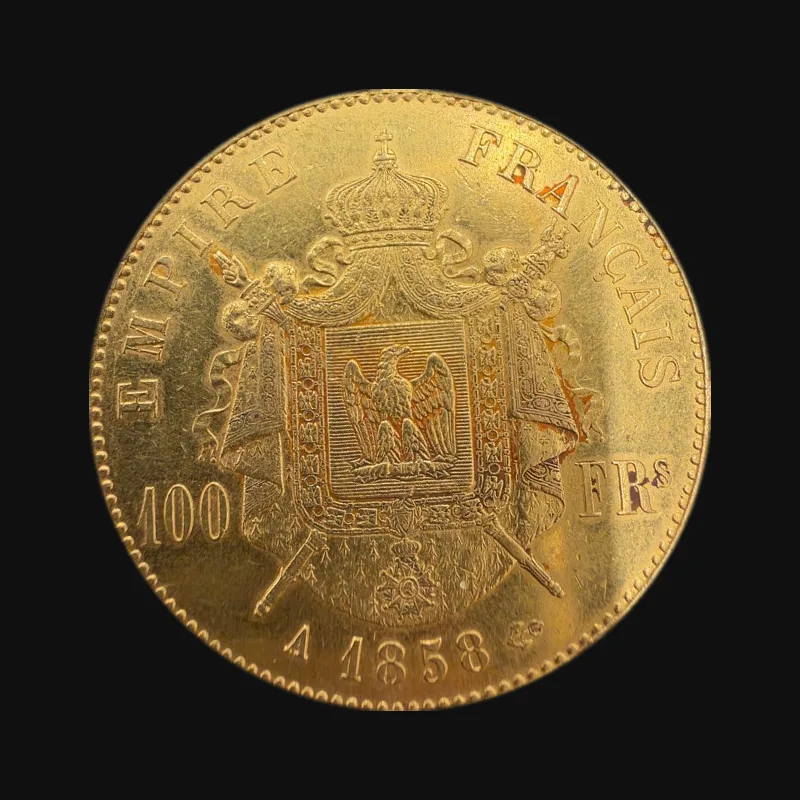
100 francs gold dated 1858, Paris mint (A), reverse with the imperial arms
Photo: Maison Or & Bijoux.
Specifications
CountryFrance
MetalGold, 900 thousandths
Weight32.26 g
Fine gold29.032 g
Diameter35 mm
PeriodsNapoleon III: 1855-1859 and 1862-1870; Genius: 1878-1914
Mint lettersA and BB on Napoleon III coins, A alone on the Genius
EngraverBarre (father or son depending on the type), after Dupré for the Genius
EdgeReligious motto up to 1906, republican motto from 1907 to 1914
Cumulative mintage346,514 bare heads, 96,950 laureate heads, 438,595 Genius
ReferencesLe Franc: F.550 (bare head), F.551 (laureate head), F.552 (Genius 1878-1906), F.553 (Genius 1907-1914); Krause: KM 786, 802, 832 (Genius 1878-1906); Gadoury: 1135, 1136, 1137, after CoinVarieties

A gold coin that almost fills the palm: that is often how the 100 francs stands out in a family box. Created under Napoleon III and taken up by the Third Republic, it was struck from 1855 to 1914 in just over 880,000 examples overall, all types combined. Its pure gold, 29.032 g, equals that of five napoléons.

Identification

Gold 100 francs: Napoleon III and the Genius: how to recognise it

Obverse

For the Empire, the emperor's right-facing profile with the legend “NAPOLEON III EMPEREUR”: an unadorned head on the 1855 to 1859 dates, a laurel-crowned head on the 1862 to 1870 dates; signature BARRE under the neck. For the Republic, a standing winged figure writing on a tablet, flanked by the Gallic rooster and a fasces with a hand of justice, legend “RÉPUBLIQUE FRANÇAISE”.

Reverse

For the Empire, a shield with the imperial eagle on a thunderbolt, ringed by the collar of the Legion of Honour and backed by a mantle; legend “EMPIRE FRANÇAIS”; “100” and “FRS” placed on each side; mint and date in the lower part. For the Republic, value and year framed by a wreath.

Edge
Two raised texts follow each other: “DIEU PROTEGE LA FRANCE” (God protect France) on the imperial years and on Genius coins up to 1906, then “LIBERTÉ ÉGALITÉ FRATERNITÉ” on Genius coins from 1907 to 1914. A plain edge is only seen on patterns and burnished flans.
Engraver
Désiré-Albert Barre for the laureate head and for the Genius, which he engraved after Augustin Dupré's 1792 drawing. For the bare head, sources differ: Désiré-Albert according to BDOR and Abacor, his father Jacques-Jean Barre according to CoinVarieties.
Dates and mintages

Gold 100 francs: Napoleon III and the Genius: key dates

The table favours coins from the BB mint, nearly all of them low-mintage, and the Genius dates that matter to a collector. The lowest imperial figure remains that of 1865 A; for the Genius, four years fall below 500 coins.

Gold 100 francs: Napoleon III and the Genius: dates and mintages
DateLetterMintageRemark
1855A50,901Plain-edge proof known
1855BB5,049
1858A92,050Plentiful mintage
1858BB1,928Rarest bare-head BB
1859A21,626End of the bare head
1862A6,650
1862BB3,078First laureate BB
1863BB5,078No Paris striking
1865A1,517Empire minimum
1866BB3,075
1867BB2,807
1869BB12,230 or 14,412Last BB, figure uncertain
1878A12,814First Genius date
1879A38,601Two anchor privy marks
1887A234Low mintage
1889A100Absolute minimum
1894A143Low mintage
1896A400Low mintage
1906A30,247Old motto on the edge
1907A20,000New motto on the edge
1913A30,184Last striking before the war
1914A1,281Date struck in 1921

Mintage sources: BDOR and Abacor, in agreement; type classification following Le Franc. Two BB figures are debated: 1859 BB (14,710 at BDOR, 14,698 at CGB after Le Franc 2023, 9,305 at CoinVarieties) and 1869 BB (12,230 at BDOR, 14,412 at CoinVarieties). The 1879 total groups both privy marks, which CoinVarieties does not separate. Other Paris dates under the Empire: 1856 (56,803), 1857 (103,447), 1864 (5,536), 1866 (9,041), 1867 (4,309), 1868 (2,315), 1869 (28,872), 1870 (10,460).

Start with the scale and the calliper

Before reading anything, two measurements are enough to place the coin: 35 mm across and 32.26 g. No other French circulating gold coin reaches these values. A coin of the same design but 28 mm and 16.13 g is a 50 francs, which reads “50 FR” on the reverse; a 21 mm coin belongs with the Napoleon III 20 francs or the 20 francs Genius.

The same measurements act as a first filter against copies, made in low-grade gold or gilt metal. A weight gap, an unusual thickness, a colour that is too yellow or uneven edge letters should lead to a closer examination. The guide on fake coins (in French) gives the full method.

Napoleon III: bare or laureate head

The portrait without a wreath belongs to the first years, 1855 to 1859. The laurel appears in the emperor's hair in 1862, on a coin that stayed in production until 1870. In between, no regular date exists.

On the reverse, the letter next to the date separates Paris (A) from the BB mint. The latter produced only nine dates, from 1855 to 1869, all in small quantities, from 1,928 coins in 1858 to about 14,000 in 1859 or 1869. In some years only one mint was at work: Paris in 1856 and 1857, BB in 1863. The guide to mints (in French) presents every letter used on French coinage.

The Genius edge as a dating clue

Under the Republic there is a single mint letter, A, and a single design, Dupré's Genius. What changes is the edge inscription. From 1878 to 1906 it repeats “DIEU PROTEGE LA FRANCE”, as under the Empire. From 1907 it carries “LIBERTÉ ÉGALITÉ FRATERNITÉ”. Le Franc therefore files the Genius under two numbers, F.552 and F.553.

Checking that edge and date agree is a quick and reliable test. A Genius dated 1909 with the religious formula, or a 1902 with the motto, matches no official coin.

A decree in 1854, demonetisation in 1928

According to BDOR and Abacor, the gold 100 francs was established by a decree of 12 December 1854, together with the 50 francs. It served as a large metallic denomination under the Second Empire, until the war of 1870 halted production. Of the last imperial issue, 1870 A, few coins are thought to remain: BDOR states that it was almost entirely melted down.

The Third Republic revived it in 1878, a world's fair year, like 1889. Striking was rare and irregular at first, then yearly from 1899 to 1913. The 1914 date was only produced in 1921. The monetary law of 25 June 1928, which introduced the Poincaré franc, stripped it of legal tender status, again according to BDOR and Abacor. For what came next, see 19th-century French coins and the gold coins page (both in French).

Rarities, patterns and privy marks

The most sought-after Genius dates are 1889 (100 coins), 1894 (143), 1887 (234) and 1896 (400), followed by 1914 (1,281). Under the Empire, 1865 A (1,517), 1858 BB (1,928) and 1868 BB (1,982) are the lowest mintages.

Alongside ordinary strikes there are exceptional pieces. In 1855, a plain-edged Paris proof bears an A on the obverse, accompanied by patterns. For the laureate head, BDOR cites 1861 proofs on burnished flans, with a five-pointed star under the neck instead of the bee and a six-pointed star in place of the mint letter, then patterns of 1862 and 1868. For the Genius, Le Franc and BDOR mention 30 burnished flans and two patterns in 1878, a burnished flan issue in 1900, and the two privy marks of 1879: plain anchor and barred anchor.

What wears a large gold coin down

High points go first. On Napoleon III, it is the hair near the ear and the cheek on the bare head, the laurel leaves on the laureate head; on the reverse, the eagle, the thunderbolt and the collar. On the Genius, the shoulder and chest fade before the feathers, then the rooster; the reverse wreath loses its detail.

The coin's weight works against it: in a bag or a box, it knocks and scratches. These contact marks weigh on the grade as much as wear does. Avoid any cleaning, which leaves lasting traces. To go further: grades of preservation and the risks of cleaning (in French). Among the other large French gold coins of the 19th century, see also the gold 40 francs (in French).
In Mougins

Gold 100 francs: Napoleon III and the Genius in Côte d'Azur

Until 1860, Mougins was part of the Var department. That year, the arrondissement of Grasse, to which the village belongs, was attached to the new Alpes-Maritimes department, formed with the County of Nice. A bare-head 100 francs struck between 1855 and 1859 therefore dates from a time when Mougins still belonged to the Var. Beyond that, we found no written record specific to the village: today these coins mostly turn up in estates and collections around Grasse, among other gold coins. A numismatist can examine yours during a free valuation.

Gold 100 francs: Napoleon III and the Genius: frequently asked questions

How much does a gold 100 francs weigh and how much gold does it contain?

It weighs 32.26 g, of which 29.032 g is fine gold, since the alloy is 900 thousandths. Its diameter is 35 mm.

Can a Napoleon III gold 100 francs carry the republican motto on its edge?

No. Every Empire coin has the “DIEU PROTEGE LA FRANCE” edge. The motto “LIBERTÉ ÉGALITÉ FRATERNITÉ” only appears on Genius coins dated 1907 to 1914.

What is the rarest date of the Genius 100 francs?

1889, with only 100 coins according to BDOR and Abacor. Then come 1894, 1887 and 1896.

Is the gold 100 francs of 1929-1936 a variant of this coin?

No. It is a different type, known as Bazor, 21 mm and 6.55 g, with a head of the Republic in a Phrygian cap, which never circulated in everyday use.